
A new product rarely begins with a perfectly formed plan.

Usually, there is a rough idea, a few conversations, perhaps a sketch on a whiteboard and a long list of questions. Will people actually use it? Which features matter? Is the workflow confusing? Would anyone pay for it?
Those questions are difficult to answer from a presentation.
They become much easier when someone can actually use the thing.
That is why prototypes have always been useful in product development. The problem is that creating a convincing prototype has traditionally taken enough time and money to make experimentation feel like a project in itself.
AI is changing that part of the process.
A working prototype can tell you things a meeting can’t
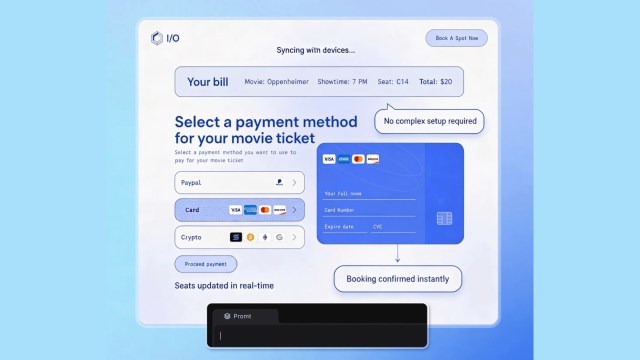
Imagine a team planning an app for booking specialist services.
On paper, the process sounds straightforward. A customer chooses a service, selects a time, enters their details and pays. Everyone in the meeting agrees that it sounds simple.
Then someone actually uses the prototype.
The booking screen asks for too much information. The available times are difficult to understand. The payment step feels like it comes too early. The confirmation message doesn’t tell the customer what they need to bring.
None of those issues may have appeared during the planning meeting.
This is why prototypes are valuable. They turn assumptions into something people can react to.
The old problem was the cost of getting there
The difficulty was rarely the idea of prototyping itself.
It was the work involved in producing something realistic enough to test.
A proper prototype might require designers, developers and product managers to spend days or weeks working together. If the team later decided that the concept wasn’t worth pursuing, much of that work would have little value beyond the lessons learned.
AI-assisted development changes the economics of that first experiment.
Instead of building every component manually, teams can describe the product they have in mind and generate a functional starting point. They can then test it, identify problems and decide what deserves more attention.
That makes it easier to treat early development as an experiment rather than a major commitment.
This is useful for more than startups
Startups are obvious beneficiaries because they often need to prove an idea before they have the resources to build a full product.
But established companies have plenty of reasons to prototype as well.
A retailer might want to test a new loyalty programme internally before rolling it out to customers. A university could experiment with a student-facing portal. An agency might need to demonstrate a custom workflow to a client before agreeing on the scope of a larger project.
In each case, the prototype isn’t necessarily the final product.
It is a way of finding out whether the proposed product makes sense.
Emergent brings the prototype and development process closer together
Emergent is one of the AI-powered platforms working in this area. It allows users to describe applications in natural language and generates the components needed for a full-stack project, including the frontend, backend, database, APIs and business logic.
The resulting application can then be changed through additional prompts. That matters during prototyping because the first version is rarely the one a team wants to keep.
A user might decide that a form needs to be redesigned, a workflow should happen in a different order, or another service needs to be connected. Instead of treating each change as a separate development assignment, the application can continue to evolve through instructions.
Emergent supports web and mobile applications and can be used for projects such as SaaS products, dashboards, customer portals, internal tools, booking platforms, websites and AI-powered applications. GitHub integration is also available for teams that want to bring projects into a conventional development workflow.
There is a free way to experiment
Emergent’s Free plan includes 10 monthly credits, core platform features, web and mobile app development, one-click LLM integration and access to its latest AI models.
The Standard plan costs $20 per month or $204 annually and includes 100 monthly credits, private project hosting, GitHub integration, task forking and the option to purchase additional credits.
For heavier projects, the Pro plan costs $200 per month or $2,004 annually. It includes 750 monthly credits, a one million-token context window, high-performance computing, custom AI agents, advanced reasoning capabilities and priority customer support.
A prototype can save more than development time
There is a tendency to think of faster development as simply a way to finish projects sooner.
That misses part of the value.
A prototype can prevent a team from spending months building something that looked sensible in a meeting but doesn’t work particularly well in practice. It can expose a confusing workflow before customers encounter it and reveal which features are worth keeping before resources are committed to everything else.
AI doesn’t remove the need for those decisions. If anything, it makes them possible earlier.
And that may be one of the more useful changes in software development. When the cost of trying an idea falls, businesses don’t have to be quite so certain that an idea will work before they give it a chance.
Also Read: A Late Arrival Can Change Which Hotel Makes Sense