Some of the most useful software a company uses will never appear in an app store.

It might be a small tool that helps a finance team reconcile information, an internal request system used by the operations department, or a dashboard built around numbers that matter to one particular business. These applications can save people time, but they have historically been difficult to justify as standalone software projects.
That is starting to change as AI-assisted development becomes more accessible.
A business no longer has to decide immediately whether an internal idea deserves a large technology budget. It can explore the idea first, build a working version and find out whether employees actually use it.
Internal software often starts with an annoyance
The starting point is rarely a grand technology strategy.
Someone notices that the same spreadsheet gets updated every Friday. A manager keeps asking employees for the same information. Two teams maintain separate lists that contain almost identical data. An approval that should take ten minutes routinely takes two days because it has to move through email.
These problems are mundane, but they accumulate.
A company might tolerate them because commissioning software for a relatively small inconvenience has traditionally seemed excessive. Developers have bigger projects to work on, and external software may not fit the process closely enough to be worth adopting.
AI changes the threshold for experimenting with these smaller ideas.
Not every internal tool needs to become a major platform
There is a tendency to think about software in terms of large products with years of development behind them.
Internal applications don’t always need that scale.
A team may simply need a searchable record, a form with a few approval stages, or a screen that brings information from several places together. The value comes from making one particular process easier.
That also makes internal software a useful place to experiment with AI-assisted development. The audience is usually limited, feedback can be collected quickly and the business can make changes without redesigning an entire customer-facing product.
If an experiment turns out to be unnecessary, there is less damage in stopping.
Employees can influence the product while it is being built
One advantage of a shorter development cycle is that employees can become part of the process much earlier.
Suppose a company creates a simple application for handling equipment requests. The first version might seem complete until the people responsible for fulfilling those requests start using it.
They may point out that certain requests need additional information. Perhaps a supervisor needs to see a different view. Maybe the warehouse team needs a status that wasn’t included in the original design.
Those discoveries are normal.
When software takes months to build, making such changes can feel expensive. When the first version can be produced and modified more quickly, feedback becomes less disruptive to the project.
The result can be a tool shaped by the people who actually depend on it.
AI also changes who can initiate a software project
Internal software ideas often come from people who are closest to the problem, not from the IT department.
An operations manager knows where a process is breaking down. A sales manager knows which information is difficult to track. A finance team knows which reports require unnecessary manual work.
They may not know how to build an application themselves.
Natural-language development creates a different starting point. Instead of presenting an idea as a technical specification, a person can describe the users, workflow, information and desired outcome in ordinary language.
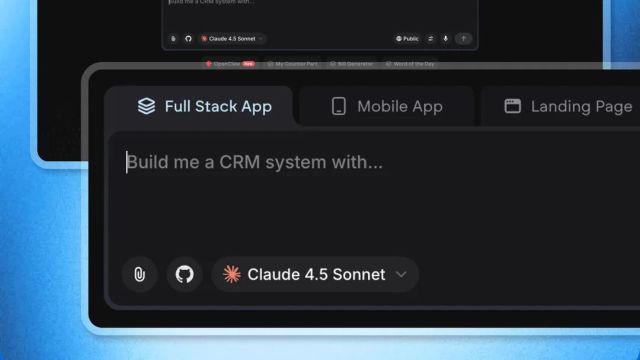
Emergent is one platform that follows this model, generating full-stack web and mobile applications from natural-language instructions. For a business exploring an internal tool, that can make the initial development stage more approachable and give technical teams something concrete to review rather than asking them to begin with a blank project.
That distinction is important. AI can help more people participate in the creation process, but security, permissions, integrations and production readiness still need appropriate technical oversight.
The economics make smaller experiments easier
The financial calculation around internal software is changing as well.
Emergent offers a Free plan with 10 monthly credits, covering its core platform and capabilities such as web and mobile app development, one-click LLM integration and access to the latest AI models.
Its Standard plan costs $20 per month or $204 per year, with 100 monthly credits and additions including private project hosting, GitHub integration, task forking and the ability to purchase additional credits. The Pro plan costs $200 per month or $2,004 per year, offering 750 monthly credits together with a 1-million-token context window, high-performance computing, custom AI agents, advanced reasoning capabilities and priority customer support.
For an internal project, that kind of structure can make it easier to begin with a limited experiment instead of committing to a substantial software build upfront.
There are still reasons to keep internal apps simple
The fact that an application is only used inside a company does not mean it can ignore engineering standards.
Internal tools can contain sensitive information. They can also become surprisingly important. A small application that begins as a convenience may eventually become the place where a team stores records or manages a critical process.
That is why businesses should resist turning every successful experiment into a giant system.
If a simple tool solves the problem, there may be little reason to keep adding features. If it becomes business-critical, that is the point at which stronger security, monitoring, backups, access controls and technical ownership become increasingly important.
A different kind of software backlog
Companies have always had more software ideas than they could afford to build.
The difference now is that some of those ideas may be cheap enough to investigate.
A useful internal application does not have to be revolutionary. It can simply remove an unnecessary step from a process that employees repeat every day. AI-assisted development makes it more realistic to explore those small opportunities instead of automatically placing them at the bottom of the technology backlog.
And sometimes the most valuable software project isn’t the one that changes the business. It is the little application that finally fixes the irritating thing everyone had quietly learned to work around.
Also Read: The TFIT Beauty Finds That Can Take You From Barely-There Makeup to Full Glam