

Every business has at least one process that everyone complains about but nobody has fixed.
It might be a spreadsheet that needs updating several times a day. It could be a form that employees fill out and then someone manually transfers the information somewhere else. Perhaps a manager receives updates by email and spends an hour every afternoon turning them into a report.
These jobs are rarely difficult in isolation. The problem is that they keep coming back.
When a company is small, people tend to work around them. As the business grows, those little inefficiencies become harder to ignore.
That is where custom software can make sense, and AI is making it easier to explore that option.
Start with the workflow, not the software
When businesses think about automation, the first instinct is often to search for a tool.
That can work if the process is common enough. But a company’s workflow may have developed around its own customers, staff, suppliers or industry requirements, which makes finding a perfect off-the-shelf product surprisingly difficult.
A better starting point is often to map what actually happens.
Who enters the information? Where does it go next? Who needs to approve it? What happens when something is rejected? Which parts are repeated manually?
Once those questions are answered, it becomes much easier to see whether a piece of software could handle the process.
Some of the best candidates are boring
There is a tendency to associate app development with exciting customer-facing products.
But a simple internal application can sometimes save more time than a flashy new app.
A field services company could use one system to assign jobs, collect updates from technicians and keep customers informed. A distributor might build a tool for tracking orders across different locations. An agency could create a client portal that brings approvals, files and project updates together.
None of these ideas needs to become a massive technology project.
The value comes from removing repetitive work that employees have been doing for months or years.
AI changes who can explore the idea
Previously, turning one of these workflows into an application generally meant involving developers from the outset.
AI-assisted development creates another possibility. Someone who understands the process can describe it in everyday language and use that description to generate an initial application.
The person building it still needs to be specific. AI can’t decide which approval should happen first or what information the finance team actually needs to see. Those decisions have to come from the people who understand the business.
But once those requirements are clear, AI can handle much of the technical groundwork.
That makes it easier to experiment with smaller applications that might never have justified a conventional development project.
Emergent can build around a specific workflow
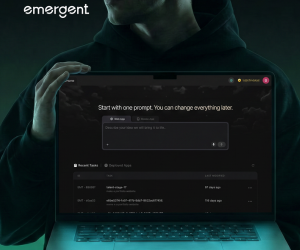
Emergent is an example of a platform designed for this kind of AI-assisted development. Instead of requiring users to build individual technical components themselves, it can turn natural-language instructions into a full-stack application.
That includes the interface people interact with, along with the backend, database, APIs and business logic supporting it.
The application can then be changed as the workflow develops. If a company decides that managers need an additional approval step, employees should see different information, or another service needs to be connected, those requirements can be described and incorporated into the existing project.
The platform supports web and mobile applications, with potential uses ranging from internal tools and dashboards to customer portals, SaaS products, booking systems and AI-powered applications. GitHub integration is available for teams that want to continue development within an established version-control workflow.
What you pay depends on how much you’re building
For someone exploring a small idea, Emergent’s Free tier comes with 10 credits each month. It provides access to core platform features, web and mobile development, one-click LLM integration and the latest AI models.
The Standard plan is $20 a month, with an annual price of $204. Users get 100 monthly credits, along with private project hosting, GitHub integration and task forking. Extra credits can be purchased separately when necessary.
Teams doing more substantial work can opt for Pro at $200 per month or $2,004 annually. That plan comes with 750 monthly credits, a one million-token context window, high-performance computing, custom AI agents, advanced reasoning capabilities and priority customer support.
Not every manual task needs an app
This is probably the part businesses should be careful about.
If a task takes five minutes once a month, building software for it isn’t going to achieve much. Sometimes a spreadsheet really is the simplest solution.
The case for custom software becomes stronger when the same process happens repeatedly, involves several people, creates opportunities for mistakes, or requires employees to move information between multiple systems.
AI doesn’t change that calculation. It simply makes the “could we build something for this?” question easier to investigate.
For businesses that have accumulated years of manual processes, that could lead to an interesting change. Instead of automatically accepting an inefficient workflow as part of the job, teams can start asking whether the process itself could be turned into software.
Also Read: Sleeping Masks for Overnight Hydration on Tired Skin from Amazon