
Having an app idea is easy. Figuring out how to turn that idea into something people can actually use is where things usually get complicated.
For a founder without a technical background, the traditional route can feel intimidating. There are programming languages to understand, developers to find, technical decisions to make and a long list of terms that have very little to do with the original business idea.
That can create an odd situation where someone knows exactly what problem they want to solve but cannot easily build the product needed to solve it.
AI-powered development is starting to close that gap.
You don’t have to start with code
The biggest shift is in how a person can communicate with the development process.
Instead of beginning by choosing a programming framework or figuring out how a database should be structured, a founder can begin by explaining the product itself.
What should the user see? What happens after they sign up? Which information should be stored? What should happen when someone submits an order, makes a booking or sends a request?
Those are questions a business owner is much more likely to understand than questions about application architecture.
AI can take those requirements and translate them into the technical components needed for an application.
That makes the first step feel considerably closer to product planning than traditional programming.
The founder still has to know what they want
There is a catch, and it is an important one.
AI does not automatically know how a business should operate.
If a founder asks for a booking app, they still need to decide whether customers can cancel, how payments should work, what happens when a slot becomes unavailable and who receives notifications. The clearer those requirements are, the more useful the resulting application is likely to be.
This is actually where non-technical founders can have an advantage. They may not know how to write the underlying code, but they often know the customer, the market and the problem better than anyone else involved in the project.
AI simply gives them a more direct way to turn that knowledge into something tangible.
The first app doesn’t need to answer everything
Another mistake founders can make is trying to build the entire business at once.
A new product might eventually need payments, analytics, customer accounts, notifications, administration tools and a dozen other features. Trying to include everything in version one can make the project unnecessarily complicated.
A better approach is to identify what the first version actually needs to prove.
If the idea is a marketplace, perhaps the initial application only needs to let buyers browse products, contact sellers and submit an order request. If it is a service platform, the first version might focus on bookings and customer communication.
Once people start using it, the founder has something much more valuable than assumptions: feedback.
Where Emergent fits into the process
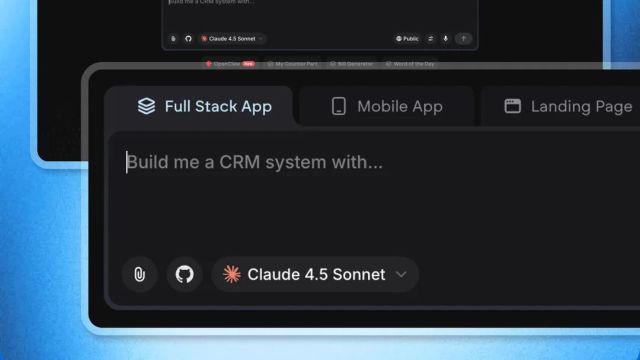
Emergent is built around the idea that an application can begin with a description rather than a traditional coding workflow.
A founder can explain what the product should do in natural language, and the platform can generate the different layers required for a full-stack application, including the frontend, backend, database, APIs and business logic.
The project can then be developed through further instructions. If users discover that a particular screen is confusing or the founder decides to add another part of the workflow, those changes can be described and worked into the application.
That makes it useful for more than just first-time builders. Developers can use the platform for prototyping and faster development, while businesses can explore internal tools, customer portals, dashboards, SaaS products, booking systems and other applications without beginning every project from scratch.
GitHub integration also gives technical teams the option of bringing projects into a familiar version-control environment.
You can try it without paying first
Emergent’s Free plan gives users 10 monthly credits and access to the core platform, including web and mobile app development, one-click LLM integration and its latest AI models.
For people who need more room to build, the Standard plan costs $20 a month or $204 annually. It raises the allowance to 100 monthly credits and includes private project hosting, GitHub integration and task forking, with additional credits available to purchase.
The more advanced Pro plan costs $200 per month or $2,004 per year. It provides 750 monthly credits, along with a one million-token context window, high-performance computing, custom AI agents, advanced reasoning capabilities and priority customer support.
For someone testing a business idea, having a free starting point can make it easier to find out whether AI-assisted development suits the project before paying for additional capacity.
Technical expertise hasn’t become irrelevant
It would be misleading to suggest that AI has made software development completely accessible without any technical knowledge.
As an application becomes more complicated, issues such as security, performance, reliability, integrations and scalability become increasingly important. A founder building a serious commercial product may still need experienced developers to review or extend the application.
What has changed is the starting point.
A non-technical founder no longer necessarily has to wait until they have a developer on board before they can explore an idea in a meaningful way. They can describe the problem, build an early version, put it in front of potential users and learn from what happens.
That can be a significant advantage when the biggest obstacle isn’t knowing what to build, but getting the first version out of your head and into someone’s hands.
Also Read: Wet Grinders for Easier Dosa and Idli Batter Preparation from Amazon