
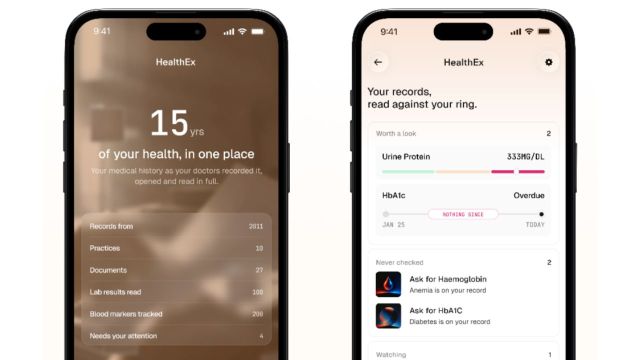
For many people, their health history exists in fragments. A blood test sits in one hospital’s system, an old prescription belongs to another clinic, and a specialist may have records that a primary-care doctor has never seen. Then there is the information being generated every day by a wearable, which usually lives somewhere else entirely.
Ultrahuman’s new HealthEx PowerPlug is built around bringing those two sides of the picture together.
Available in the Ultrahuman app in the US, the PowerPlug connects medical records through HealthEx with continuous health data from the Ultrahuman Ring. That means information such as diagnoses, medications and procedures can appear alongside measurements such as resting heart rate, heart rate variability, skin temperature and deep sleep.
The result is a timeline that gives users more context around what is happening with their health, rather than leaving medical history and everyday measurements in separate places.
Bringing medical history into the same timeline
The HealthEx PowerPlug can map 532 conditions, medications and procedures from electronic medical records into the Ultrahuman app.
Once a member chooses which records to connect and gives consent, those records can sit alongside their Ring data. A new medication, for example, can be viewed alongside the wearable measurements recorded around the same period. A diagnosis or procedure can also be seen in the context of changes in everyday health metrics.
That doesn’t mean the Ring data explains why a particular change happened. Rather, it gives people another layer of information to look at when they are trying to understand their own health history.
This can be particularly useful when someone’s care has involved several doctors or healthcare facilities. A person’s medical record can become difficult to reconstruct when different parts of it are spread across different providers.
Turning gaps in a medical record into questions
Another part of the PowerPlug focuses on follow-ups.
The connected records include dated results and medications, and the PowerPlug can identify situations where a condition, procedure or medication suggests that a particular marker may need to be checked or a follow-up may be due.
Rather than presenting that as a diagnosis or medical instruction, the feature turns it into a question that can be taken to the next appointment.
That distinction matters. The point is to help someone arrive at a consultation with a better list of things to discuss, especially when months may have passed since the previous visit.
A more useful starting point for the next doctor’s appointment
The PowerPlug also creates a Visit Pack intended for use during appointments.
It brings together relevant information from the connected medical record and the medications a person is taking, while also putting that information alongside their wearable data. It can flag questions and tests that may be worth raising with a doctor based on the available records.
This is aimed at a fairly ordinary problem in American healthcare: there often isn’t much time to reconstruct a patient’s history during an appointment.
The average US doctor’s appointment lasts about 15 minutes, according to PBS NewsHour. When someone has seen several specialists or received care at different facilities, a significant part of that time can be spent simply trying to establish what has already happened.
Having that information assembled before the appointment can make the conversation more focused.
How HealthEx connects the records
The HealthEx platform handles the medical-record side of the integration.
After verifying their identity, a member can choose the care sites from which they want to retrieve records. HealthEx can then locate records across the places where that person has received care, including through the Trusted Exchange Framework and Common Agreement (TEFCA).
Consent remains with the individual. Members decide which records to connect, can choose what they share with the health application, and can stop sharing those records.
This gives the PowerPlug a different role from simply collecting another stream of health data. It is bringing together information that already exists in the healthcare system with measurements being collected continuously by the Ring.
Where the Ring fits in
The Ultrahuman Ring is already collecting health signals throughout the day and night. The HealthEx integration gives those measurements more historical context by placing them on the same timeline as medical events.
A person’s resting heart rate, HRV, skin temperature and deep-sleep data can now be viewed alongside diagnoses, procedures, medications and test results that they have chosen to connect.
For someone reviewing their own health history, that can make it easier to see when different events occurred and prepare more specific questions for a healthcare professional.
It is still important to draw a line between context and medical interpretation. The HealthEx PowerPlug is a general wellness feature, not a medical device, and it does not diagnose, treat, cure or prevent diseases or conditions.
Privacy is part of the setup
Because the feature involves medical records, control over the data is a central part of how HealthEx and Ultrahuman describe the integration.
Members actively consent to connecting their records, and they can stop sharing them. Ultrahuman and HealthEx also state that they do not sell member health data, use it for advertising or use it to train AI models.
HealthEx’s separate Wallet also gives individuals access to a unified longitudinal view of their health history and is currently available for free directly through HealthEx.
What comes next
The HealthEx PowerPlug is currently rolling out in the United States to Ultrahuman Ring users through the PowerPlugs section of the Ultrahuman app.
It costs $4.99 per month or $45.99 per year.
The integration is also expected to extend further across Ultrahuman’s ecosystem. Deeper HealthEx connections with PowerPlugs such as Vitamin D, GLP-1 and Respiratory Health are planned, which could add medical-record context to more of the health information already being tracked through the platform.
For now, the central change is fairly straightforward: medical history no longer has to sit completely apart from the continuous data generated by a wearable. By putting the two on the same timeline, the HealthEx PowerPlug gives people another way to understand their health history and, perhaps more practically, walk into their next appointment with the relevant information already in front of them.
Also Read: Fruit Infusion Tea Collections for Refreshing Evening Drinks from Amazon