
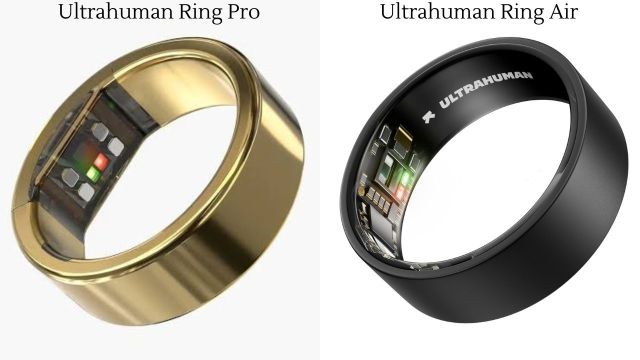
Smart rings can look deceptively simple. From the outside, there is not much room for a dramatic difference between one generation and the next. The interesting changes tend to sit underneath the surface: how much data the ring can store, how its sensors work, how long the battery lasts and what happens when it needs to be charged.

That becomes clear when the Ultrahuman Ring PRO is placed alongside the Ultrahuman Ring AIR.
Both are titanium smart rings built around continuous health tracking, with sleep and recovery among their central uses. Both come in sizes 5 to 14, carry a 100-metre water-resistance rating and use temperature, movement and optical heart-rate sensing.
The differences are largely in the hardware surrounding those basics.
The same idea, with different hardware underneath
The Ring AIR has a 2.4 mm profile and weighs around 2.4 grams, making it particularly light for something designed to be worn around the clock. Its titanium construction uses a PVD coating, while the inner surface uses hypoallergenic plastic.
The Ring PRO moves to a 2.65 mm thickness, depending on size, and weighs between 3.3 and 4.8 grams. Its construction combines titanium, PVD coating, epoxy and polycarbonate, with a hypoallergenic plastic and titanium inner surface.
Neither ring is particularly complicated to look at. The more significant change is what Ultrahuman has put inside the additional space.
Battery life is one of the biggest jumps
The Ring AIR is rated for 4–6 days of battery life.
The Ring PRO stretches that to up to 15 days, although the actual figure depends on its operating mode. Turbo Mode is rated at around 12 days, while Chill Mode can extend beyond 15 days.
That is a substantial change for something that is intended to stay on a finger day and night. Longer battery life also means fewer interruptions to sleep and recovery tracking, where gaps in data can matter more than they might with occasional activity tracking.
The charging setup has changed along with it.
Ring AIR comes with an open wireless charging pad that takes around 180 minutes for a full charge. Ring PRO uses the PRO Charging Case, which connects magnetically through Ultrahuman’s UltraSnap system.
The case itself can provide up to 45 days of battery, giving the charging system a much larger role than simply topping up the ring.
The charging case is more than a battery pack
The PRO Charging Case is effectively another piece of the Ring PRO hardware.
It can store up to a year of ring data, compared with the Ring AIR’s approximately four days of internal storage. It also includes an integrated speaker and in-app proximity tracking through Find My Case, while haptic confirmations and an LED provide feedback during charging.
Firmware updates can also be accelerated through the case’s direct connectivity.
The case supports USB-C and 5W Qi wireless charging, and uses aluminum, stainless steel and plastic in its construction. There is also a charger reset button and JEITA-compliant charging.
Ring AIR keeps things simpler: the wireless charging pad connects to the ring, with firmware updates handled through Bluetooth.
More processing happens on the Ring PRO
The processor is another important difference that is easy to miss from the outside.
Ring AIR uses a single-core processor.
Ring PRO moves to a dual-core processor with on-chip machine learning. That gives the newer ring more computing capability directly on the device, rather than relying as heavily on a connected phone for processing.
Storage has also increased dramatically. Ring PRO can hold up to 250 days of data, using internal and external flash storage. Ring AIR has around four days of internal storage.
That matters most in situations where the ring isn’t regularly communicating with the app. The PRO’s larger storage buffer means more of the continuous record can remain on the hardware itself.
The sensing hardware has been redesigned
Both rings use temperature sensing, a 6-axis IMU and optical heart-rate monitoring.
The difference is in the optical heart-rate system.
Ring AIR uses a PPG sensor, while Ring PRO has a redesigned PPG system intended to improve signal quality during sleep and recovery.
That distinction is worth noting because the rings are not simply tracking a completely different set of health signals. The newer model is building on the same basic sensing approach while changing the hardware used to collect those signals.
Both devices can take up to 14 days to calibrate, according to the specifications.
There is also a new approach to ring safety
Ring PRO introduces ProRelease Technology, which is designed to allow the ring to be safely cut in situations involving finger swelling or injury.
There is no equivalent feature listed for Ring AIR.
It is the sort of specification that may never become relevant during normal use, but it reflects how wearable hardware has to account for the fact that a ring is physically enclosed around a finger.
The design language has evolved without changing the basic format
Both generations retain the same size range of 5–14 and the same 100m/328ft water-resistance rating.
The colour line-up overlaps, too. Ring PRO is available in Bionic Gold, Space Silver, Aster Black and Raw Titanium, while Ring AIR adds Matte Grey to Raw Titanium, Aster Black, Bionic Gold and Space Silver.
The visual differences are therefore more restrained than the internal hardware changes.
Two generations of the same wearable idea
Looking at the specifications side by side makes the progression easier to see.
Ring AIR established a compact wearable centred on continuous sleep and recovery tracking, with a 2.4-gram titanium body, several days of battery life and the sensors needed to collect everyday health data.
Ring PRO keeps that basic format but pushes several pieces of the hardware further: a longer-lasting battery, a more capable processor, substantially greater on-device storage, redesigned PPG sensing and a charging case that can store data and extend the overall charging cycle.
So the comparison is less about two completely different products and more about how a smart ring can evolve without changing its basic premise. The Ring PRO retains the small, wearable form factor of the AIR while putting considerably more of the computing, storage and charging infrastructure around the finger rather than leaving it to the phone.
Also Read: International Hot Sauce Collections for Bold Flavours from Amazon