
Most people who wear a smart ring are used to checking what happened overnight. They look at their sleep duration, heart rate, HRV and recovery score, then get on with the day. Ultrahuman is now offering users another reason to wear their ring to bed: their overnight data can become part of scientific research.

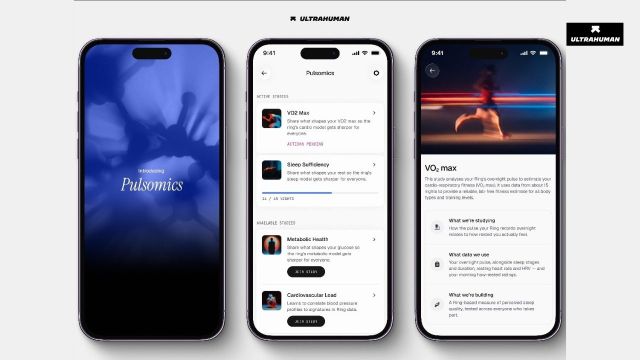
The company has introduced Pulsomics, an opt-in research programme built into the Ultrahuman app. Ring users can take part from home, simply by wearing their Ring as they normally would. The programme is designed to help researchers build health models using data collected from people living their everyday lives, rather than relying only on controlled clinical settings.
Why real-world wearable data matters
A health algorithm might work well for one group of people and perform less reliably for another. Skin tone, body composition and even the way a wearable sits on the finger can affect the signals it captures. Yet many health models have historically been developed using relatively small, less diverse groups, often under supervised conditions.
Pulsomics aims to widen that pool. Participants provide information such as age, sex, height, weight, ethnicity and skin tone during onboarding. This context is combined with overnight pulse signals and other health information, including lifestyle data from the Ring, continuous glucose monitoring, blood panels and VO2 Max tests.
The idea is to build larger datasets that reflect differences between people and the conditions in which they actually live. A model trained on thousands of ordinary nights across different populations may eventually offer more useful estimates than one developed from a limited group in a laboratory.
Three studies are now open
Pulsomics begins with three research projects, each looking at a different aspect of health.
The Sleep Sufficiency Study combines daily sleep journals with pulse signal data. Rather than assuming everyone needs the same recommended number of hours, the research aims to understand how much sleep an individual may actually need.
The Glucose Metabolism Study looks at the relationship between pulse signals and recent blood test results. The longer-term goal is to explore whether the Ring can provide useful metabolic insights without requiring a separate laboratory measurement every time.
The VO2 Max Study pairs pulse signals with fitness measurements and laboratory references. VO2 Max is commonly used to assess cardiovascular fitness, but measuring it accurately often requires specialised testing. This research aims to explore estimates that work across a much wider range of people.
More studies are planned, including research into cardiovascular load and longer-term sleep patterns.
What happens when you participate?
Joining is straightforward. You select a study in the Ultrahuman app, provide the requested health information and continue wearing your Ring as usual. The device automatically records short windows of raw pulse signal overnight.
Participants can see which studies they have joined, how many nights they have contributed and the overall progress of the programme. They will not receive individual diagnoses or personal research results. Pulsomics is a wellness research initiative, not a medical testing service.
The programme builds on earlier research involving Ultrahuman data, including published work on its Metabolic Score in Scientific Reports, a large sleep consistency and glucose control study, and an ongoing Mayo Clinic study involving patients taking GLP-1 medications.
Participation, privacy and availability
Pulsomics is free and voluntary for Ultrahuman Ring AIR and Ring PRO users aged 18 and above. Participants can leave the programme whenever they choose.
Ultrahuman says data is de-identified before being used for research, is not sold and is not shared with advertisers, employers or insurers. Published findings use aggregated information from multiple participants.
There is a trade-off worth understanding before joining. You are contributing personal health context and overnight wearable data to research, without receiving an individual health assessment in return. For users comfortable with that arrangement, Pulsomics offers a way to support studies that could make wearable health insights more representative. And the contribution does not require a clinic appointment or a change to your nightly routine.
Also Read: Car Battery Monitoring Devices to Check During Amazon Great Indian Festival Sale