AI app development has moved well beyond asking a chatbot to write a few lines of code.
The more interesting question now is what happens when the AI is given responsibility for much more of the application. Can it create something people can actually use? Can it handle the database behind the scenes? What about user accounts, payments, external services or a mobile interface?
The answer depends on the platform and the complexity of the project, but the range of things that can be built has expanded considerably.
For businesses and founders considering these tools, that makes the practical use cases more interesting than the technology itself.
Websites are only the beginning
A simple website is an obvious starting point for AI-assisted development.
Someone can describe the pages they need, the information each page should contain and the actions visitors should be able to take. AI can then help turn those requirements into a working site rather than stopping at a static design.
But the same approach can be used for applications with considerably more going on behind the scenes.
A business might need users to create accounts, submit information, view their previous activity and receive updates. A membership business could want a portal where customers manage their accounts and bookings. An agency might need a private area where clients can review projects and share documents.
These are applications, not just websites, and they require several technical layers to work properly.
Internal tools can be surprisingly useful
Some of the best candidates for AI-assisted development are tools that a company would never sell to customers.
Think about an operations team that needs to combine information from different sources into one dashboard. Or a sales team that wants a particular way of tracking leads that doesn’t match the CRM software it already uses.
These tools are often too specific for a commercial software company to build exactly as required, but important enough that employees feel the limitations every day.
An AI development platform can provide a way to create a more tailored solution without treating every internal tool as a major software engineering project.
AI applications can be built on top of AI
There is also an interesting second layer to this.
AI development platforms can be used to create applications that themselves use AI. A company might want an internal assistant that works with its own information, a customer-facing tool that generates responses, or an application where AI forms part of the main workflow.
That requires more than simply adding a chatbot to a webpage. The application needs somewhere to store information, a way to handle users and permissions, and connections to the relevant AI models or external services.
This is where full-stack AI development becomes particularly useful.
What Emergent brings together
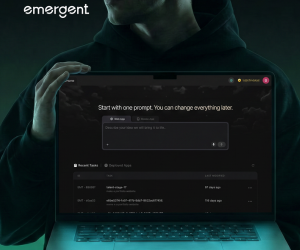
Emergent is designed to handle the different parts of an application within one development workflow. A user can describe what they want to build in natural language, while the platform works across the frontend, backend, database, APIs and application logic.
The result can be a web or mobile application rather than simply a piece of generated code.
There is also room to keep working on the project after the first version has been created. Users can describe changes, add features and connect external services as the requirements become clearer. GitHub integration gives developers another option for managing and continuing work on projects.
That makes the platform relevant to a fairly broad group of users, from someone testing a first product idea to a development team looking to speed up prototyping.
How much you can do depends on the project
AI app development shouldn’t be confused with pressing a button and getting a finished enterprise system.
The more complicated the application becomes, the more important testing, security, architecture and technical oversight become. An application handling sensitive information or a large number of users has requirements that go well beyond generating its initial code.
For simpler projects, however, the technology can remove a surprising amount of the initial work.
That’s why the most useful way to look at these platforms is perhaps as development environments rather than magic app generators. They can take care of substantial pieces of the build, while people remain responsible for deciding what the product should do and whether it actually works well.
Emergent has different levels of access
For someone who simply wants to experiment, Emergent’s Free plan provides 10 credits each month, along with its core platform features, web and mobile app development, one-click LLM integration and access to its latest AI models.
The Standard tier is $20 per month, with an annual option at $204. It comes with 100 monthly credits and adds private project hosting, GitHub integration and task forking. Users can also purchase additional credits rather than moving immediately to a higher tier.
For more intensive projects, Pro costs $200 per month or $2,004 annually. The plan provides 750 monthly credits, a one million-token context window, high-performance computing, custom AI agents, advanced reasoning capabilities and priority customer support.
The useful question is what problem you’re trying to solve
It is easy to get caught up in the novelty of asking AI to build software.
For businesses, the more useful question is usually much simpler: What would we actually use it for?
If the answer is a customer portal that removes a tedious process, a dashboard that brings scattered information together, an MVP that needs testing, or a mobile application that would otherwise take months to get started, AI development becomes considerably more interesting.
The technology is still evolving, and it won’t make every software project straightforward. But the range of applications that can be explored without starting with a traditional development process is getting wider, and that is probably the more important story.
Also Read: The Everyday Settings Giving Bullet’s Microdramas Their Dramatic Edge