

If you’ve ever booked a flight and then checked the price again a few days later, you already know how frustrating it can be.

Sometimes it drops. Sometimes it goes up. And most of the time, you’re left wondering if you booked at the right moment.
The honest answer is, there isn’t a perfect day or time.
But there is a pattern to how prices behave. And once you understand that, booking starts to feel a lot less like guesswork.
The biggest mistake: booking too early or too late
Most people fall into one of two extremes.
They either book way too early thinking it’ll be cheaper, or they wait too long hoping for a last-minute drop.
Both can backfire.
Airlines usually release tickets early at standard prices. They don’t start low and gradually increase. Instead, prices move based on demand.
So:
- Too early = you might not get the best deal
- Too late = prices often rise as seats fill up
The sweet spot is somewhere in between.
The general booking window that works
While it varies by route, a rough pattern tends to hold:
- Domestic flights: about 3–6 weeks before travel
- International flights: about 6–12 weeks before travel
This is usually when prices are relatively stable and not yet affected by last-minute demand.
It’s not a rule, but it’s a good starting point.
How prices actually move
Flight prices don’t move in a straight line.
They go up, drop slightly, stay steady, then spike again. Sometimes you’ll see small dips before a bigger rise.
What you’re looking for isn’t the absolute lowest price ever.
You’re looking for a price that feels normal or slightly lower than what you’ve been seeing.
That’s where Skyscanner helps.
Use Skyscanner to get context, not just a price
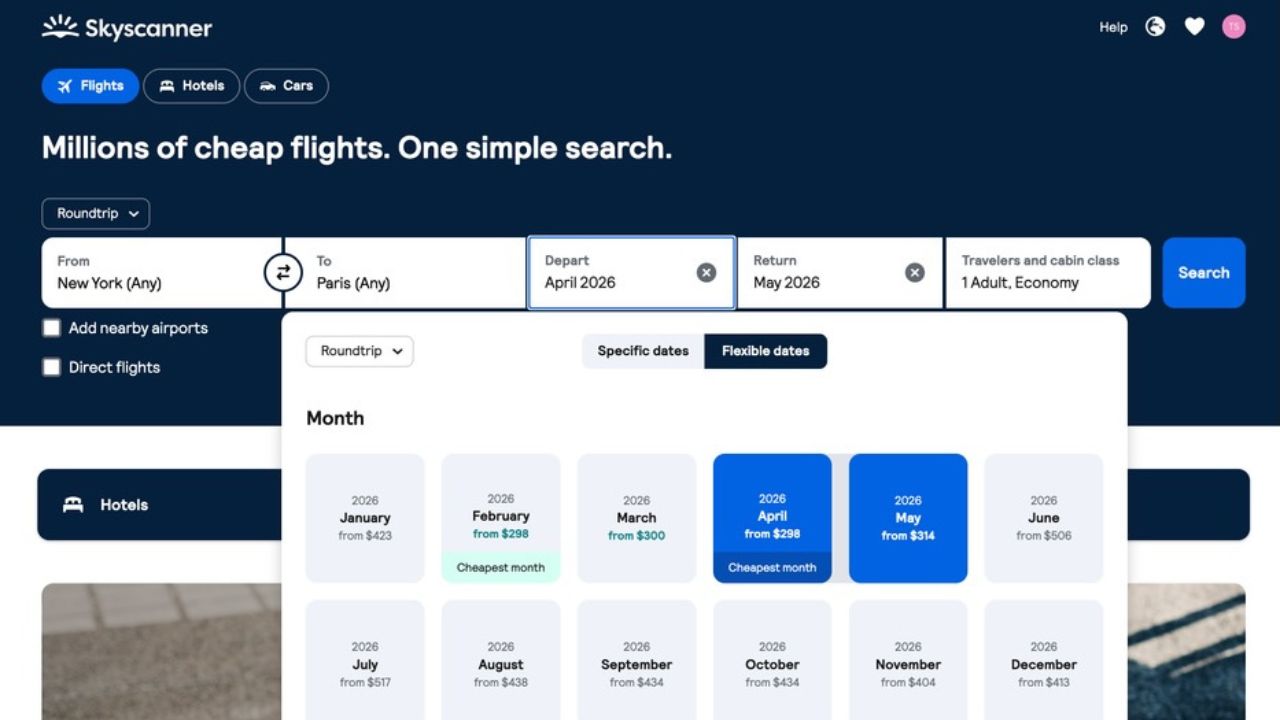
Instead of checking one date and one price, use the tools to see the bigger picture.
Calendar view
Look at prices across nearby dates. If your selected date looks higher than the rest, it probably is.
Cheapest Month
If your plans are flexible, this shows when fares are generally lower instead of forcing you into one timeframe.
Price alerts
If you’re not sure whether to book yet, track the route. After a few updates, you’ll start seeing how prices move.
This gives you context, which is what most people miss.
When waiting makes sense
Waiting can work, but only in certain situations.
It makes sense when:
- You’re booking well in advance
- Prices seem higher than nearby dates
- You’re not traveling during peak season
In these cases, watching the trend for a few days or weeks can help.
When waiting doesn’t help
Sometimes, waiting just makes things worse.
If you’re:
- Traveling during holidays or peak season
- Booking close to your departure date
- Seeing prices steadily rising
Then waiting usually isn’t your friend.
At that point, booking sooner is safer.
The “good enough” rule
This is the part people struggle with.
There’s always a chance the price might drop later. But there’s also a chance it won’t.
Instead of chasing the perfect deal, aim for something that feels reasonable based on what you’ve seen.
If the price:
- Matches the general range
- Doesn’t look like a spike
- Fits your budget
…it’s usually fine to book.
A simpler way to think about it
Instead of asking “Is this the lowest price?”, try asking:
“Is this a normal price for this route right now?”
That’s a much easier question to answer once you’ve looked at the calendar and tracked it for a bit.
The takeaway
There’s no exact moment when flights are always cheapest.
But there is a pattern.
Book too early, and you might miss better pricing. Book too late, and you’ll likely pay more.
The middle window is where most good deals sit.
Skyscanner doesn’t tell you when to book. It just shows you enough information so you can decide with a bit more confidence instead of guessing.