
Comedy has always been a little unpredictable. A joke that sounds brilliant on paper can fall flat when someone says it aloud, while an ordinary situation can become hilarious because of one person’s reaction.
That unpredictability is part of what makes comedy difficult to get right, especially when there isn’t much time to set up a scene.
Microdramas have an interesting advantage here. They don’t necessarily need elaborate comic situations. Sometimes a strange premise, an awkward encounter or a character finding themselves in completely the wrong situation is enough to get things moving.
Indian entertainment has a long history of this kind of humour. Some of the funniest moments come from putting ordinary people into circumstances that are anything but ordinary. A character suddenly discovers that their family is hiding something, someone ends up pretending to be richer than they are, or a perfectly normal day takes a turn because one person makes an unfortunate decision.
The situation itself becomes the joke.
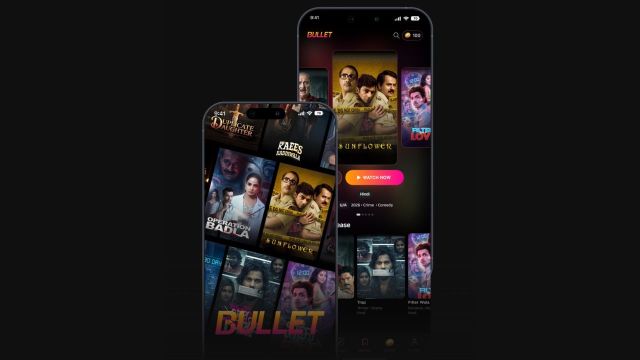
Bullet’s catalogue has room for plenty of that playful storytelling. Ameer Golgappewaali, for instance, has a title that already feels like it belongs to a slightly chaotic comedy. Putting “ameer” and “golgappewaali” together creates an immediate contrast, and it is hard not to wonder what kind of world could produce such a situation.
Billionaire Waiter works in much the same way. There is an obvious contradiction in the premise, and that contradiction gives the drama something to play with. A wealthy person working as a waiter raises questions about identity, motives and what happens when other people eventually discover the truth. It can be funny without needing to turn every scene into a conventional joke.
That is often where situational comedy works best.
The characters don’t necessarily think they’re being funny. They are simply trying to deal with a problem, while the audience can see how ridiculous the circumstances have become. Someone is trying desperately to keep a secret, another person is drawing the completely wrong conclusion, and the audience gets to watch the confusion grow.
Microdramas can make good use of that because the format allows the joke and the plot to move together.
A comic scene doesn’t have to exist separately from the narrative. A misunderstanding can create the next conflict. An awkward encounter can reveal something important. A character’s attempt to escape an embarrassing situation can make everything considerably worse.
That keeps the humour connected to what is happening rather than turning the series into a collection of unrelated gags.
There is also something distinctly Indian about the way family and social relationships can become part of the comedy. Status matters, relatives have opinions, neighbours notice things they probably shouldn’t, and a small misunderstanding can become everyone’s business before anyone has figured out what actually happened.
Titles such as OMG: Mera Baap Toh Bigshot Nikla play into that sense of social chaos. A revelation about someone’s family background isn’t just personal. It changes how everyone around them behaves, which creates plenty of room for awkwardness, disbelief and exaggerated reactions.
Even Diwali Homecoming: Thoda Luck Aur Thoda Dhamaka suggests a lighter kind of drama where celebration and trouble are likely to arrive together. That mixture is familiar to Indian audiences because festivals in popular entertainment rarely go entirely according to plan.
Bullet doesn’t limit itself to comedy, of course. Its catalogue moves across romance, suspense, family drama and other genres, and that variety is useful because humour often works best when it appears alongside something else. A romantic situation can become funny, a thriller can have an unexpectedly amusing character, and a family conflict can become entertaining simply because everyone involved reacts differently.
That makes comedy particularly useful in short-form entertainment. There isn’t a need to build an elaborate comic universe before the humour can begin. Give the characters an awkward situation, let their personalities collide, and the entertainment can take care of itself.
Perhaps that’s why the funniest dramas are not always the ones with the most jokes.
Sometimes all they need is a ridiculous situation, a few people making questionable decisions and enough time for the consequences to catch up with them.
Also Read: Melt, Massage, Rinse: Cleansing Balms Worth Exploring on Tira