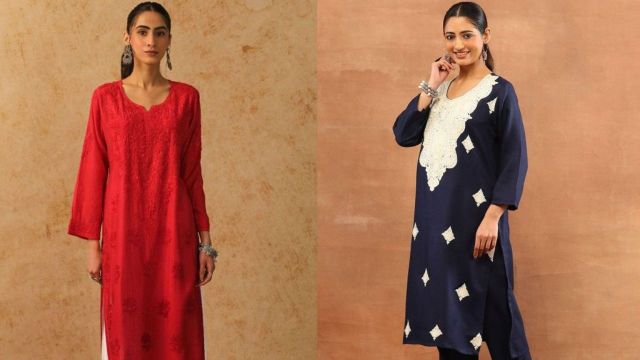
Best House of Chikankari kurtis to check out: Some kurtis don’t need loud prints to feel memorable—when the threadwork is delicate and the fit is clean, your outfit carries its own identity. House of Chikankari pieces tend to sit in that sweet zone: craft-forward, wearable, and easy to style for both everyday and occasion dressing.
5 House of Chikankari kurtis to consider (for a wardrobe you’ll actually rewear)
These picks are curated from House of Chikankari, focusing on silhouettes that usually deliver the most “worth owning” value: a classic straight kurta for daily polish, an A-line for movement, a soft cotton pick for summer comfort, a dressier fabric option for evenings, and a versatile neutral that works with everything. The goal is not more kurtis—it’s better kurtis you can repeat with jeans, straight pants, and palazzos without the look feeling repetitive.
Chikankari is often treated as a single aesthetic, but it behaves very differently depending on base fabric, embroidery density, and hem construction. A white cotton kurta with an asymmetric hem can read crisp and everyday, while a chanderi silk piece shifts the same embroidery language into something more light-catching and event-friendly. Fabric choice also dictates comfort: cotton and mulmul typically feel airier for long hours, while rayon tends to drape fluidly and look smoother on camera.
Care matters because the embroidery is the most vulnerable part of the garment. Gentle hand washing in cool water with mild detergent, minimal agitation, and no wringing are common best practices for preserving chikankari threads and keeping the fabric from distorting. House of Chikankari also recommends hand wash or dry clean for its chikankari outfits, which aligns with the broader care guidance for this craft.
How this edit is organised
These five pieces are read as a mini-wardrobe: one everyday white cotton, one festive chanderi silk, one peak-summer mulmul, one winter-leaning wool co-ord, and one easy drape rayon set.
The five pieces, in detail
House of Chikankari Women White Cotton Chikankari Embroidered Kurta

A white cotton chikankari kurta is the most versatile base in this group, and this one adds shape through a geometric yoke, an empire-style line, and an asymmetric hem. The long roll-up sleeves also make it adaptable across seasons and settings, from office mornings to travel days.
Pros
- Cotton is typically breathable and comfortable for extended wear.
- The asymmetric hem and empire styling add interest without relying on heavy embroidery.
Cons
- White cotton can demand more careful stain management.
- An asymmetric hem can feel less “formal” than a straight hem for traditional occasions.
Pro-tip
- Wash gently in cool water and avoid wringing to protect the embroidery and prevent skewing at the hem.
House of Chikankari Women Embroidered Chikankari Chanderi Silk Kurta
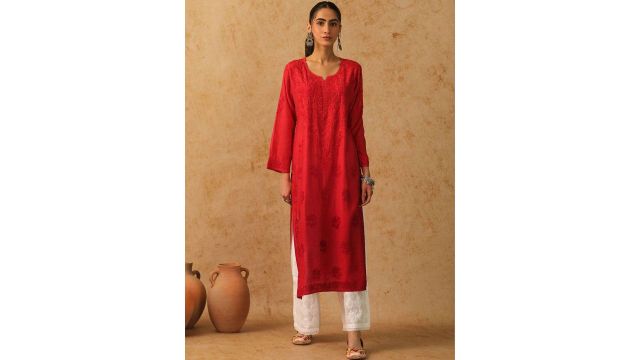
This red chanderi silk kurta is the dressiest single kurta in the lineup, mainly because chanderi is known for its lightweight feel and subtle sheen. The knee length and straight hem keep it classic, while the abstract embroidery makes it feel less predictable than florals.
Pros
- Chanderi’s lightness and sheen can look elevated even with minimal styling.
- Knee length is easy to pair with both straight pants and wider palazzos.
Cons
- Brighter colours often need more caution during washing; gentle hand wash separately is a sensible constraint.
- Chanderi can feel more occasion-led than daily cotton, especially for commute-heavy routines.
Pro-tip
- Keep accessories matte (oxidised silver, minimal gold) so the fabric’s sheen stays the focal point.
Also Read: Delicious Sugar-Free Chocolates To Satisfy Cravings Without The Guilt
House of Chikankari Women Pink Mulmul Chikankari Embroidered Kurta
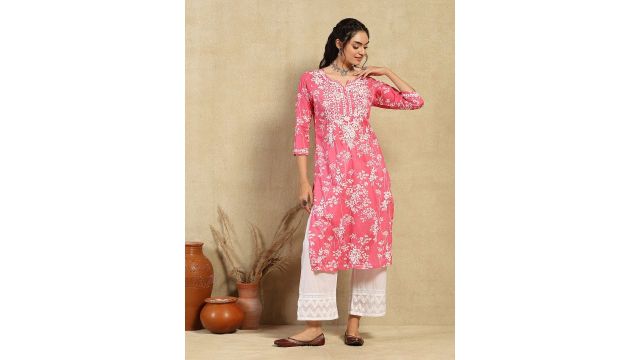
Mulmul is the “hot-weather specialist” here: lightweight, breathable, and typically comfortable when temperatures climb. With a notch neck, ethnic motifs, and calf length, it leans daytime and easygoing, especially for errands, casual workdays, or travel.
Pros
- Mulmul is widely described as lightweight and breathable, making it well-suited to warm, humid weather.
- Calf length with side slits usually improves ease of movement.
Cons
- Very light fabrics can be more prone to creasing and may require careful innerwear choices.
- Hand wash is simple, but it needs consistency to keep the garment looking new over time.
Pro-tip
- Steam from a distance or iron on the reverse at a low setting to protect the embroidery while smoothing the fabric.
House of Chikankari Women Ethnic Motifs Embroidered Regular Aari Work Pure Wool Kurta with Trousers
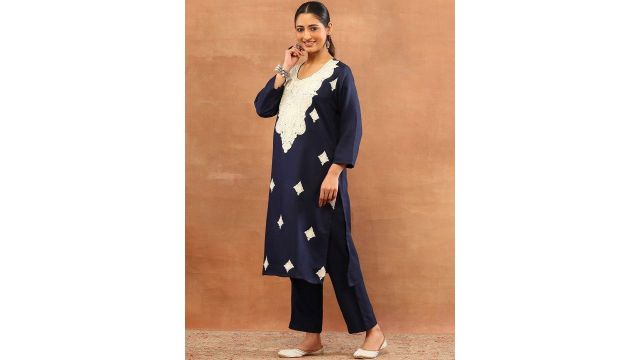
This is the outlier in the best way: a pure wool kurta with trousers, featuring aari work rather than chikankari. It’s positioned for cooler months and for anyone who wants an ethnic set that doesn’t feel “summery” by default.
Pros
- Wool makes the set naturally more seasonal and structured.
- A two-piece set with solid trousers is easy to style without overthinking.
Cons
- Wool can feel too warm indoors or in transitional weather.
- Separate gentle washing is important, and frequent cleaning may be less convenient than cotton.
Pro-tip
- Limit washing frequency and focus on airing between wears; spot-clean small marks early to avoid full washes.
House of Chikankari Women Dark Pink Rayon Chikankari Embroidered Kurta Set
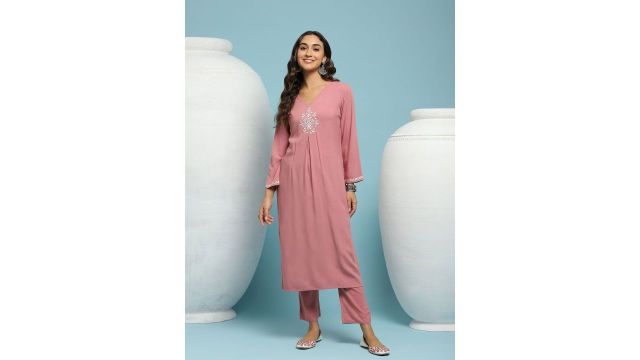
This rayon kurta set is for drape and polish. Viscose rayon typically falls smoothly, which can make embroidery sit flatter and look more “even” in photos, while the long sleeves and V-neck give it a more styled, slightly contemporary silhouette.
Pros
- Rayon’s fluid drape can look sleek with minimal effort.
- A set removes the need to match bottoms, which is useful on busy days.
Cons
- Rayon can be less forgiving in high heat and may show wear if handled roughly.
- The finish can change if over-washed or dried aggressively, so gentle care matters.
Pro-tip
- Use a small amount of product when ironing (low heat, inside out) and avoid pulling the fabric while it’s damp to maintain shape.
Frequently Asked Questions
Which fabric is the easiest for peak summer: cotton, mulmul, or chanderi?
Mulmul is widely described as especially lightweight and breathable, with cotton close behind for everyday sturdiness; chanderi is light too, but its sheen often makes it feel more occasion-driven.
What’s the safest at-home wash approach for chikankari?
Gentle hand washing in cool or lukewarm water with mild detergent, short soaking, and no wringing is commonly recommended to protect delicate embroidery.
When does dry cleaning make more sense than hand washing?
Dry cleaning can be the safer choice when the fabric is delicate, the colour is saturated, or the embroidery is dense and more prone to snagging or distortion; House of Chikankari itself recommends hand wash or dry clean for its chikankari outfits.
How can embroidery be protected during ironing?
Iron on the reverse side on low heat and avoid pressing directly onto raised threadwork; it helps prevent flattening and stress on stitches.