
You are standing in the grocery aisle, or perhaps scrolling through an online store, trying to pick up a jar of ghee. One label says A2, another mentions Bilona, and a third talks about traditional preparation. They all look convincing enough. But if you have ever wondered what these terms actually tell you about the product, you are not alone.

Buying ghee has become a little more complicated than it used to be. There are more varieties available, more claims on packaging and, naturally, a wider range of prices. And while a higher price does not automatically mean a better product for your kitchen, understanding a few details can help you make a more informed purchase.
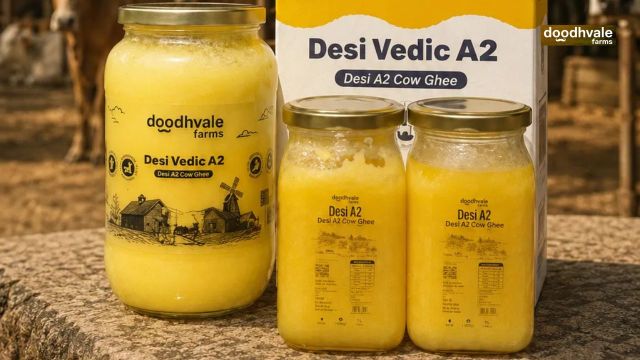
Start with the milk source. Is the ghee made from cow milk or buffalo milk? Does the brand identify the breeds? These aren’t particularly difficult questions, but they can help you understand what you’re buying. For instance, Doodhvale Farms makes its Cow A2 Desi Ghee using milk from Sahiwal and Gir cows raised on its farm in Sonipat, Haryana. Its Royal A2 Buffalo Desi Ghee, on the other hand, comes from Murrah buffaloes.
The distinction is useful when comparing products because the brand is telling you something specific about its sourcing rather than simply using the words traditional or premium. Doodhvale also has a Classic Cow Bilona Ghee for everyday cooking, which is made from cow milk sourced from its own farm.
Then comes the production method, and this is where the word Bilona deserves a closer look. It isn’t just another name for homemade-style ghee. The traditional process begins with milk being set into curd. That curd is hand-churned to separate the makkhan, which is then slow-simmered to make ghee. Each stage is part of the method, so if a product carries the Bilona label, it is reasonable to check whether the brand explains how it follows this process.
Doodhvale’s ghee range follows this method and is produced in small batches. The brand describes its ghee as danedaar, meaning it has a grainy texture, along with a strong aroma. These characteristics can provide you with an idea of how the product is supposed to be, but they are not enough to definitively say how the product was made.
Another detail that deserves attention is whether the brand provides information beyond what is printed on the jar. We often take packaging claims at face value, particularly when buying familiar kitchen staples. But knowing whether a company makes batch-level information available gives you something more concrete to check. Doodhvale Farms, for example, provides batch laboratory reports and its FSSAI licence through the Doodhvale app.
Of course, there is also the question of how much ghee you actually need. A 330 ml jar makes sense if you’re trying a new variety or buying for a smaller household. An 825 ml jar may be more practical for regular consumption, and then a 5-litre Cow A2 Dolchi is available for larger families that use ghee frequently. Choosing the right quantity matters because buying a bigger pack simply because it looks like better value isn’t particularly useful if it takes months to finish.
And don’t overlook the intended use. A richer buffalo ghee may appeal to someone who regularly prepares halwa, sweets and parathas, while a cow ghee intended for everyday cooking might be a more familiar choice for dal, rotis and tadka. Doodhvale’s Royal A2 Buffalo Desi Ghee and Classic Cow Bilona Ghee cater to these different preferences.
A ghee label cannot tell you everything, but it can tell you quite a lot if you know what to look for. Before adding another jar to your grocery order, spend a minute checking the milk source, production method, available product information and pack size. It is a small habit, but it makes the difference between buying something because the packaging sounds impressive and choosing something you actually understand.
Also Read: Paneer Tikka, Hara Bhara Kebab and Dahi Ke Kebab: Starters for Guests Who Skip Meat