
Some food items are so popular in India that they need no introduction. Dosa falls in this category. It is perfect for busy weekday mornings, lazy Sunday brunches, evening hunger pangs and even those days when you just want something familiar. Crispy on the outside and served with chutney and hot sambar, dosa is one of those dishes that rarely disappoints.

The beauty is that it fits so many occasions. For a student living away from home, a masala dosa can be comfort on a plate. For the office-goer, it is the kind of breakfast that fills you up without slowing you down. Families often have their own dosa rituals, from who gets the crispiest one to the endless debate about coconut chutney or tomato chutney.
Dosa Evolution
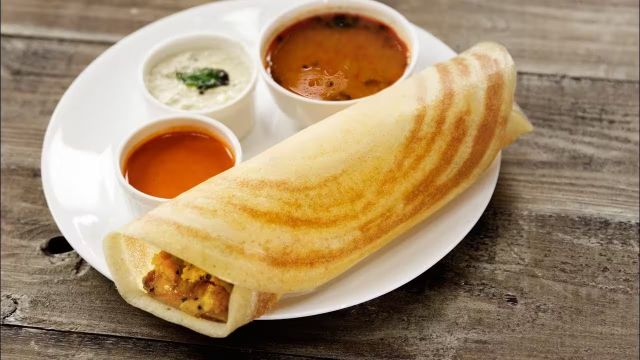
For many of us, the love affair begins with the masala dosa. The crispy exterior holding a warm potato filling, cooked with onions, mustard seeds, curry leaves and mild spices, makes it more of a full meal than breakfast. Every region has its own take. Karnataka often leans towards a crisp, ghee-rich version, while Tamil Nadu’s dosas can carry a slightly tangier note from the fermented batter. Either way, it remains one of the most ordered and most recognisable versions across the country.
Then comes the plain dosa, which proves that simplicity can hold its own. It’s thin, it’s golden, and it comes with sambar and chutney, so it doesn’t need any fillings or anything else to impress. A good plain dosa has that great mix of a crunchy texture and a soft middle, and the little bit of sourness that comes from the fermentation gives every bite some extra flavor.
Not a one-version dish
Take for example rava dosa. It is thinner, crispier and full of tiny lace-like holes which gives it a completely different texture from the classic dosa. Since it does not require fermentation, it became a restaurant favourite for quick preparation, and for diners, it offers a lighter but equally satisfying experience.
Set dosa moves in the opposite direction. Soft, thick, and usually served in a stack, it is less about crunch and more about comfort. Popular in Karnataka, it often arrives with vegetable sagu and chutney, making it feel more like a wholesome breakfast than a snack.
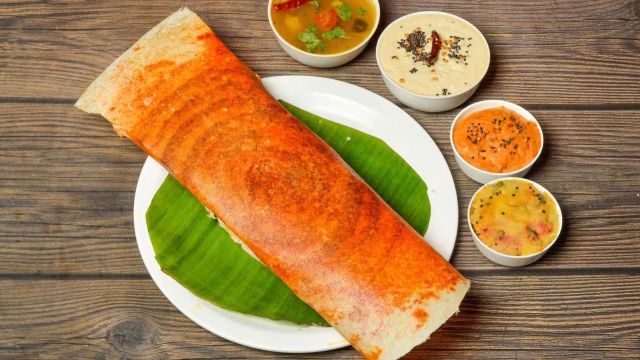
And then there is the paper dosa, which is as much about theatre as taste. Long, oversized, and dramatically crisp, it usually arrives hanging off the plate, drawing attention before the first bite even happens.
Dosa’s journey itself goes back centuries, with roots in South India, particularly Tamil Nadu and Karnataka. What began as a simple fermented batter of rice and urad dal slowly travelled across the country, adapting to local tastes and ingredients. Fermentation made it easier to digest, while slow roasting on a hot tawa created the texture people keep coming back for.
The modern dosa, of course, has become more experimental. Cheese dosa, paneer dosa, Mysore dosa, schezwan dosa, pizza dosa — street vendors and restaurants have reworked it in countless ways. Health-focused diners now have millet, quinoa, and multigrain versions that align with changing eating habits.
Making dosa at home has its own charm but getting that restaurant style crispness is not always easy. On days when the batter is missing or time is short, ordering becomes the simpler option. Be it a masala dosa, Mysore dosa, plain dosa or rava dosa, Zomato has made it easy to get that familiar comfort straight to your doorsteps.
Also Read: Body Washes on Tira Beauty That Feel Like the Skincare Version of a Deep Breath