
There are probably very few ingredients in an Indian kitchen that get used as casually as ghee. A spoonful goes over hot dal, another finds its way onto a freshly made roti, and a little more might be added to a pan before the spices go in. Most households have a jar sitting somewhere in the kitchen, but ask someone how that ghee was actually made and the answer is often a shrug. We know what ghee tastes like. We don’t always know much about what goes into making it.

And that is where the conversation around traditional ghee-making becomes interesting. The process can tell you quite a bit about the product you’re buying, particularly when you’re comparing different varieties on a supermarket shelf or an online store. Terms such as Bilona, hand-churned and small-batch production are worth understanding rather than simply treating them as attractive words on a label.
The Bilona method, for instance, follows a sequence that is quite different from simply separating cream and processing it into ghee. Milk is first set into curd. The curd is then hand-churned to separate the makkhan, which is eventually slow-simmered to produce ghee. It is a traditional process, but it also involves several distinct stages before the finished product reaches the jar.
And you can notice some of the differences in the finished ghee itself. Doodhvale Farms, which produces its ghee using the Bilona method, describes its batches as having a danedaar, or grainy, texture and a pronounced aroma. These are characteristics worth paying attention to when you’re choosing ghee, although texture and aroma alone shouldn’t be treated as proof of how a product was manufactured.
Cow ghee and buffalo ghee aren’t quite interchangeable
Another detail that often gets overlooked is the kind of milk used. People sometimes buy ghee based entirely on the words cow or buffalo on the packaging, without considering how they intend to use it.
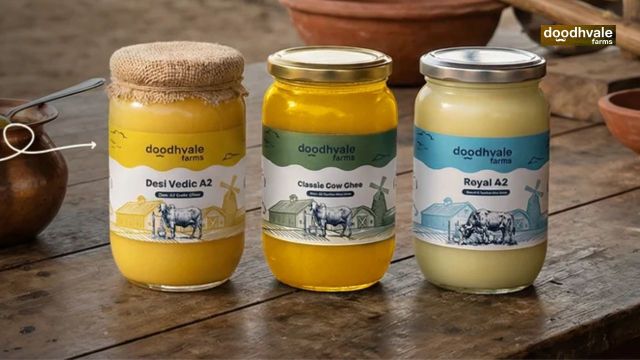
Cow ghee is a familiar everyday choice in many Indian homes. It works well with dal, rotis and tadka, where you want that recognisable ghee aroma without making it the dominant flavour of the dish. Doodhvale Farms’ Classic Cow Bilona Ghee is positioned for precisely this kind of regular kitchen use.
Its Cow A2 Desi Ghee is a separate offering, made from the milk of Sahiwal and Gir cows raised on the farm. The brand describes it as aromatic, golden and danedaar. Then there is Royal A2 Buffalo Desi Ghee, made using milk from its Murrah buffaloes. With its richer, more robust flavour, this variety is suited to preparations such as halwa, sweets and parathas.
The distinction matters because there isn’t necessarily one jar that needs to do everything. Someone who uses ghee mainly for everyday cooking might prefer a different variety from a household that regularly prepares traditional sweets or richer festive dishes.
Knowing where the ghee comes from
There is also the question of sourcing. When buying something that becomes part of your everyday meals, knowing where its raw ingredients come from can make the decision a little easier.
Doodhvale Farms operates its own 27-acre dairy farm in Sonipat, Haryana, which was established in 2017. The farm has more than 4,900 animals, including over 2,800 cows and 2,000 buffaloes, cared for by a team of more than 40 people. Milking takes place twice a day, at 4:30 am and 4:30 pm, using machines.
For buyers who want more than a general claim about farm sourcing, the brand also makes batch laboratory reports and its FSSAI licence available through the Doodhvale app. Checking these details is a more useful habit than relying entirely on packaging descriptions.
And then there is the practical side of buying ghee. A smaller jar makes sense if you’re trying a particular variety for the first time, while a larger pack may be more convenient for a household that uses it regularly. Doodhvale offers 330 ml jars, 825 ml jars and a 5-litre Cow A2 Dolchi, catering to different requirements.
Ghee may be a familiar kitchen staple, but that doesn’t mean every jar is made in the same way or intended for the same use. The next time you need to replenish your supply, it is worth looking beyond the price and the attractive packaging. Knowing the milk source, the production method and the kind of cooking you have in mind gives you a much better starting point than simply picking up whichever jar happens to be closest.
Also Read: Dhokla, Idli, Dosa and Poha: Breakfast Options When You Want a Break From Parathas