

Product managers have always sat in an interesting position within a software team.
They are expected to understand what customers need, decide which features deserve attention, work with designers and developers, and keep the product moving in the right direction. Yet one of the biggest constraints has traditionally been the distance between having an idea and actually seeing it work.
A product manager could write a detailed specification for a feature, but someone else still had to build it before the team could properly evaluate it.
AI-powered development is beginning to shorten that distance.
From specifications to something people can try
A product requirement document can explain a feature in considerable detail, but it is still a document.
There can be subtle problems that only become obvious once someone interacts with the proposed product. A button may be in the wrong place. A process might require too many steps. A feature that sounded useful may turn out to be unnecessary once the rest of the product is considered.
Traditionally, finding those issues meant waiting for design or development work to progress.
AI app builders make it possible to create a working starting point much earlier. A product manager can describe the intended workflow and generate something the team can interact with before the feature enters a conventional development cycle.
That doesn’t mean the generated version replaces the final engineering work. It gives the team something more useful to discuss than a theoretical specification.
Product decisions become easier when there is something tangible
This can be particularly helpful when teams disagree about how a feature should work.
Imagine a company debating whether customers should complete a long form in one sitting or provide information over several steps. A meeting could go around in circles for an hour.
A prototype changes the conversation.
People can try both approaches, see where they get stuck, and discuss the actual experience rather than arguing about what they imagine it will be like.
That can make product discovery more practical. Instead of trying to predict every detail before development begins, teams can actually test some of their assumptions and use the results to shape the next version.
It also changes the relationship between product and engineering
This doesn’t mean product managers should start bypassing developers.
Good software still needs engineering judgement, particularly when a product involves sensitive information, complicated integrations, significant traffic, or demanding security requirements.
What can change is how much of the early exploration needs to wait for engineering availability.
A product manager could use an AI development platform to investigate a concept, create a prototype for user research, or demonstrate a proposed workflow. Developers can then take over when the project requires deeper technical decisions or needs to be prepared for production at scale.
The boundary isn’t disappearing. It is becoming more flexible.
Emergent brings this idea into the development workflow
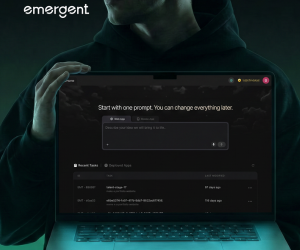
Emergent is one example of an AI-powered platform that lets users describe applications and generate a working full-stack project.
Rather than focusing only on interface design, it can produce the frontend, backend, database, APIs, and application logic. Product teams can then continue refining the project through natural-language instructions, which can be useful when an early version reveals that a workflow needs to change.
For example, a team experimenting with a customer portal could adjust the onboarding process, add a new dashboard, change how information is displayed, or connect another service without treating every alteration as a completely separate starting point.
Emergent supports both web and mobile applications and can be used for SaaS products, internal tools, dashboards, customer portals, booking systems, websites and AI-powered applications. GitHub integration also gives development teams a route into a more traditional coding and version-control workflow.
There is a fairly wide gap between experimenting and scaling
One thing product teams should keep in mind is that a successful prototype is not automatically a production-ready product.
A prototype can prove that a workflow makes sense. It doesn’t necessarily prove that the underlying architecture will handle thousands of users or that every security requirement has been addressed.
That distinction matters because AI makes it much easier to create something that looks and behaves like an application. Teams still need to evaluate what happens underneath before putting more demanding workloads through it.
For product managers, though, that doesn’t diminish the usefulness of the technology. The early stage is exactly where many ideas struggle to get enough attention to be tested properly.
Plans for different levels of use
Emergent’s Free option gives users 10 monthly credits, along with access to its core features, web and mobile app creation, one-click LLM integration and its latest AI models.
For more regular development, Standard costs $20 per month or $204 annually. It provides 100 monthly credits and adds private project hosting, GitHub integration and task forking, with additional credits available for purchase.
The Pro plan is priced at $200 per month or $2,004 per year. It increases the monthly allowance to 750 credits and includes a one million-token context window, high-performance computing, custom AI agents, advanced reasoning capabilities and priority customer support.
The product team may get a faster feedback loop
The most useful change here may have little to do with who writes the code.
It is about how quickly a product team can move from an assumption to something it can actually test.
When that gap gets smaller, product managers can experiment more freely. Designers can respond to working interfaces instead of static requirements. Developers can receive feedback on a concept before committing significant engineering time to it.
AI app builders aren’t going to eliminate the need for any of those roles. They could, however, give them more opportunities to work with the product itself earlier in the process.
And for teams where a good idea can spend weeks waiting for its turn in the development queue, that is a meaningful change.
Also Read: Body Wash Collections for Cleansing Skin Without That Dry Feeling from Amazon