
For a small business, the decision to build custom software has usually come down to one thing: whether the problem is expensive enough to justify the cost of fixing it.
That is not always an easy calculation.
Maybe employees are spending several hours each week preparing reports manually. Perhaps customers keep asking for a feature that the company’s current software cannot provide. Or there is a useful business idea sitting in someone’s notebook because turning it into an actual product would require more money and technical help than the company can spare.
In the past, those situations often ended with a compromise. The business kept using the existing tools and found ways to work around their limitations.
AI-powered development is giving businesses another option.
Custom software used to require a big commitment
Building an application traditionally meant bringing several pieces together. There was design work, frontend and backend development, databases, testing, hosting and ongoing maintenance.
Even a relatively straightforward application could therefore become a sizeable project.
That made custom software difficult to justify for smaller businesses. If a team only needed a specialised dashboard or an internal workflow tool, spending months and a substantial budget on development could seem excessive.
The alternative was to find an existing product and adapt the business process around it.
Sometimes that worked perfectly. Sometimes employees simply learned to live with the gaps.
AI changes the starting point
AI app development does not make software free or remove the need for proper development work. What it can do is reduce the amount of manual work involved in creating an initial application.
Instead of starting with code, users can explain what they want the software to accomplish.
They can describe who will use it, what information needs to be stored, which actions should be available and how different parts of the workflow should connect. An AI-powered platform can use those instructions to create a working foundation.
That changes the economics of experimentation.
A business doesn’t necessarily have to commit to a full development project simply to find out whether a particular idea is worth pursuing.
The smaller projects may benefit the most
Large software projects will continue to require serious engineering resources.
The more interesting opportunity may be the collection of smaller projects that traditionally fell through the cracks.
A company might want a simple application for tracking equipment across different locations. A service business could need a booking system that follows its own scheduling rules. An agency might want a client dashboard where customers can review work, approve changes and access files.
None of these problems is unusual.
They are simply specific enough that a generic product may not handle them particularly well.
AI makes it easier to explore whether building something tailored to that workflow is practical.
Emergent brings several parts of the build together
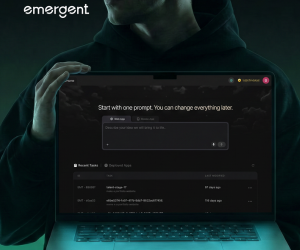
Emergent is designed around this approach to application development. Users describe what they want to create using natural language, and the platform can generate the different components that make up a full-stack application.
That includes the frontend people interact with, as well as the backend, database, APIs and business logic underneath it.
The project can then be refined as requirements become clearer. A business might start with a basic internal tool and later add another workflow, connect an external service or change how users interact with a particular feature.
Emergent supports web and mobile applications, along with use cases such as SaaS products, dashboards, customer portals, booking systems and internal business tools. Developers can also use GitHub integration when they want to continue managing a project through a familiar version-control workflow.
There is a relatively low-cost way to explore it
Emergent’s Free plan comes with 10 monthly credits and access to core features, including web and mobile app development, one-click LLM integration and its latest AI models.
For people building more regularly, the Standard plan costs $20 per month or $204 annually. It includes 100 monthly credits, private project hosting, GitHub integration and task forking, while additional credits can be purchased when needed.
The Pro plan is $200 per month or $2,004 annually. It is aimed at heavier development and includes 750 monthly credits, a one million-token context window, high-performance computing, custom AI agents, advanced reasoning capabilities and priority customer support.
That range means the cost can scale according to how much someone is actually using the platform, rather than requiring every project to begin with the same level of investment.
Cost isn’t the only thing that has changed
It would be easy to look at AI development purely as a way to make software cheaper.
There is another effect that may matter just as much.
When the initial cost and effort of building something falls, businesses can afford to experiment more. They can test a workflow, discover that it isn’t useful, change direction and try something else without having already committed a large development budget.
That is particularly relevant for small businesses, where a few thousand dollars or several months of development time can represent a significant investment.
AI isn’t going to make every custom software project simple. Complex applications still need careful planning, testing, security work and technical oversight.
But it is making the first question easier to ask: Could we build something specifically for the way our business works?
For many smaller companies, that question was once dismissed before anyone had a chance to investigate it. That is starting to change.
Also Read: Ultrahuman Photon Brings Red Light Therapy Into the Company’s Health Ecosystem