

For agencies, winning a new client is often the easy part.
The complicated bit comes afterwards, when the team has to turn a promising brief into something that works, looks good and arrives on time. Every client has different requirements, and even projects that appear straightforward can become more involved once development begins.
A website might turn into a customer portal. A dashboard may need to connect with an existing database. A simple booking system can suddenly involve payments, notifications and different types of user accounts.
The more projects an agency takes on, the more important it becomes to find ways of handling that work efficiently.
AI-assisted development is starting to become part of that conversation.
Agencies spend a lot of time building familiar things
Not every client project requires a completely new technical approach.
Login systems, dashboards, forms, admin areas, databases and API connections appear across countless projects. Developers still need to configure them properly, but recreating the same foundations repeatedly can take time that could be spent on the parts of a project that actually make it different.
AI can help with some of that repetitive groundwork.
Instead of creating every component manually, developers can describe what they need and use an AI development platform to produce a starting point. The team can then review it, make changes and adapt it to the client’s requirements.
The result isn’t necessarily fewer developers. It can mean giving developers more time for work that requires actual engineering judgement.
Client feedback becomes easier to act on
Anyone who has worked in an agency knows that the first client brief is rarely the final one.
A client sees an early version and asks for something that wasn’t originally discussed. A workflow turns out to be more complicated than expected. Another integration becomes necessary halfway through the project.
Those changes can be frustrating when every adjustment has to go through the same lengthy development cycle.
AI-assisted editing offers another way to handle some of those requests. Once the project exists, the team can describe the change and use AI to modify the relevant parts rather than rebuilding the feature from scratch.
That can be particularly useful during the prototyping and iteration stages, when the product is still taking shape.
Emergent can fit into that workflow
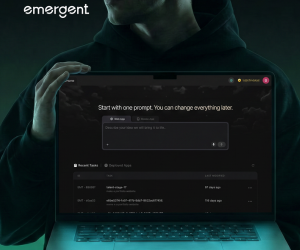
Emergent is an AI-powered application development platform that lets users describe what they want to build in natural language.
It can generate the frontend, backend, database, APIs and business logic needed for a full-stack application, giving an agency a working foundation rather than just a visual concept.
That could be useful for an agency building a client dashboard, an ecommerce experience, a booking platform, an internal business application or a SaaS product. The same environment can also be used for mobile applications and AI-powered products.
Projects can continue to evolve through further instructions, while GitHub integration provides a way for developers to work with projects through a conventional version-control system.
The important part for an agency is the flexibility. Different clients can require very different products, but the team doesn’t necessarily have to begin every project from an entirely blank slate.
There is also a practical question of cost
Emergent has a Free plan with 10 monthly credits and access to its core features, including web and mobile development, one-click LLM integration and its latest AI models.
For agencies handling more regular development work, Standard is $20 per month or $204 annually. It includes 100 monthly credits, private project hosting, GitHub integration and task forking, while additional credits can be purchased as needed.
The Pro plan costs $200 per month or $2,004 annually and is aimed at heavier workloads. It includes 750 monthly credits, a one million-token context window, high-performance computing, custom AI agents, advanced reasoning capabilities and priority customer support.
For an agency, the relevant question isn’t simply which plan has the most features. It is how much development work the team expects to run through the platform and whether the time saved is meaningful across its client workload.
Faster development can change the agency-client relationship
There is a difference between rushing through a project and removing unnecessary work.
If an agency can produce a usable first version sooner, clients have more opportunity to react to something tangible. Instead of spending weeks discussing what a feature might look like, they can see it, use it and explain what needs changing.
That can make projects more collaborative.
It can also make smaller client requests more viable. A business that previously couldn’t justify commissioning a custom dashboard or internal tool might now be able to explore one without turning it into a huge development engagement.
AI won’t eliminate the need for designers, developers or project managers. Agencies still need people who can understand the brief, make good technical decisions and ensure the final product meets the client’s requirements.
What it can do is change how much of the routine work happens before those people get to the more interesting parts of the project.
Also Read: Ultrahuman Ring PRO at $479: What’s New, What You Get and How Jade Fits In