Temperature tracking has long been part of understanding the menstrual cycle, but the traditional approach usually involves taking a temperature reading at a particular point in the morning. A smart ring takes a different route: it can keep collecting temperature data while you sleep, night after night.
The Ultrahuman Ring measures skin temperature at the finger throughout the overnight sleep window and compares each night’s reading with your own baseline. Those changes can reveal the temperature shift that follows ovulation, giving the Ring a way to confirm that ovulation has occurred.
It is worth being clear about what the Ring is measuring, though. It does not take classical basal body temperature, or BBT, because BBT refers to core temperature measured at complete rest, traditionally at a single point before getting out of bed.
Skin temperature follows the cycle
Although skin temperature and core temperature are not the same measurement, they show a related pattern across the menstrual cycle.
After ovulation, progesterone rises and causes resting temperature to increase. That shift can be seen in both core and peripheral skin temperature and generally remains elevated until the next period.
Research looking at skin temperature at different parts of the body has found that, while skin and core temperature can behave differently across the daily circadian rhythm, their changes across the menstrual cycle follow a similar direction.
That relationship is what makes overnight finger temperature useful for cycle tracking.
How the Ring measures temperature overnight
Inside the Ring is a contact NTC thermistor positioned on the inner surface against the skin.
Rather than taking one reading at a particular moment, it samples temperature throughout the sleep period. This gives the Ring an overnight temperature curve instead of a single number.
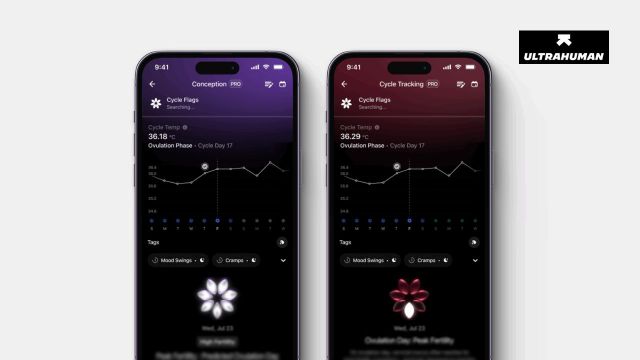
The data from each night is then turned into a nightly summary and compared with a rolling baseline built from your previous measurements. The result shown to the user is Temperature Deviation — essentially, how that night’s temperature compares with what is normal for you.
That approach also helps account for something that can make absolute skin-temperature readings difficult to interpret. Your finger temperature can change because of the room, bedding, circulation or even how the ring fits. Your personal baseline provides a more useful reference point than treating one absolute temperature as meaningful on its own.
How the Ring uses the temperature shift to confirm ovulation
The Ultrahuman app offers both Cycle & Ovulation and Cycle & Ovulation PRO through its PowerPlugs.
The basic Cycle & Ovulation PowerPlug learns a user’s temperature pattern using a 30-day baseline. Once it has established that pattern, it looks for a sustained rise above the baseline. A sequence of consecutive nights at the higher level gives the system enough evidence to identify the likely ovulation point.
Cycle & Ovulation PRO adds OvuSense technology and is designed to provide more detailed cycle insights, including ovulation confirmation and Cycle Flags.
The important part is that the Ring is not trying to determine ovulation from a single temperature spike. It is looking for a sustained change against the individual’s established pattern.
How accurate is the Ring?
Ultrahuman has tested the cycle-tracking system against hormone measurements.
In a pilot involving 22 women across 48 complete cycles, Cycle & Ovulation PRO identified ovulation at a median of one day from the peak hormone surge measured using a home urine test.
In a larger study using a urine test that measured four hormone metabolites, the Ring’s ovulation assessment agreed with the test 92.9% of the time. The study reported 100% sensitivity and a 91.7% positive predictive value.
Those figures provide useful context for the technology, although they should not be interpreted as meaning that every individual cycle will produce the same result.
Is this the same as measuring BBT?
No, and the distinction is important.
Traditional BBT is a measurement of core body temperature taken at rest, usually immediately after waking and before physical activity. The Ring measures skin temperature at the finger continuously during sleep.
The two signals are different, but both are influenced by the hormonal changes that occur across the menstrual cycle. The Ring’s advantage is the amount of data it can collect overnight rather than relying on one waking measurement.
For confirming that a temperature shift associated with ovulation has occurred, having a continuous overnight record can provide a much fuller picture. It does not turn finger skin temperature into a direct measurement of core body temperature, however.
Why does the app show temperature deviation instead of an exact temperature?
An absolute finger temperature can be surprisingly variable.
Your sleeping environment, bedding, circulation and ring fit can all affect the number. Comparing each night’s measurement with your own established baseline makes those environmental differences less influential.
It also means you are looking at the change that matters for cycle tracking rather than getting distracted by whether your finger temperature happens to be a particular number on a particular night.
How long does the Ring need before it can confirm ovulation?
The cycle-tracking system first needs time to learn your individual temperature pattern.
The baseline is built over 30 days, after which the system looks for consecutive nights showing the expected temperature shift. Once there is enough consistent evidence, it can mark the likely ovulation day.
That means the feature becomes more useful as the Ring builds a longer history of your personal cycle patterns. It is not designed to make an ovulation call from the first few nights of data.
Can you use the Ring to avoid pregnancy?
No.
The cycle-tracking feature is intended as a wellness tool for understanding your menstrual cycle. It is not a contraceptive method and should not be used on its own to prevent pregnancy.
The most useful way to think about the Ring’s temperature data is as another continuous signal that can help make the changes across your cycle easier to see. Rather than relying on a single morning measurement, you get an overnight record that can be compared with your own baseline and used to identify sustained temperature shifts associated with ovulation.
Also Read: How AI App Development Is Making Offline-First Business Apps More Practical