

A lot of business software assumes there will always be a reliable internet connection.
That assumption works reasonably well in an office. It becomes less convincing when the people using an application spend their day on construction sites, in warehouses, on delivery routes, at customer locations or travelling between them.
For these workers, losing connectivity isn’t an unusual technical failure. It is part of the working environment.
That makes offline functionality more than a convenience. In some applications, it is a basic requirement.
AI-assisted development is making it easier for businesses to explore these kinds of specialised applications without starting with a large software project.
Some jobs don’t happen next to a Wi-Fi router
Consider a technician visiting a customer’s property.
They may need to look up a work order, record what they found, take photographs, update the job status and collect a signature. If the application becomes unusable the moment the connection disappears, the technician is left taking notes elsewhere and entering everything again later.
The same problem appears in logistics, construction, agriculture, field sales and other industries where employees regularly work away from fixed offices.
The software has to accommodate the environment rather than expecting the environment to accommodate the software.
Offline mode changes how an app has to work
Adding offline capability isn’t simply a matter of displaying a message that says “No internet connection.”
The application needs to know what information should remain available without a connection. It needs a way to store new information locally and determine what happens when connectivity returns.
That creates several questions.
If two people update the same record while offline, which version should be kept? What happens if a user submits information that conflicts with a change made elsewhere? How much data should be stored on the device? What happens if the application is closed before unsynchronised information has been sent?
These are product and engineering decisions, not just interface details.
The useful part of an offline app is often quite small
Businesses don’t necessarily need their entire software system to work without an internet connection.
A field worker may only need access to today’s assignments, a small collection of customer details and the ability to record what happened during each visit.
That narrower requirement can make an offline-first application more practical.
Instead of trying to reproduce every function of a company’s main business system on a phone, developers can create a focused mobile experience around the tasks that have to continue when the connection disappears.
AI-assisted development can be useful during this stage because teams can describe those specific workflows and iterate on the application without having to design the entire business platform at once.
Building around the real working environment
This is one area where software development benefits from spending time with the people who will actually use the application.
A manager might imagine that field employees need access to every customer record. The employees may explain that they only need five pieces of information while standing at a job site.
A product team might want a complicated reporting screen. The person working in the field may simply need a large button for “job complete” and an easy way to attach photographs.
Those differences matter.
An offline application should be designed around what someone needs to accomplish when connectivity is limited, rather than trying to reproduce a desktop application on a smaller screen.
AI can shorten the path from workflow to mobile app
Natural-language development makes this type of specialised software easier to explore.
A business could describe a workflow such as: a technician signs in, sees assigned jobs, opens the relevant customer record, records work performed, attaches photographs, adds notes and synchronises the changes when a connection becomes available.
That description gives a development system a starting point.
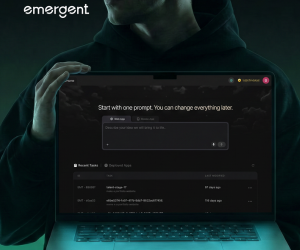
Emergent is one platform that can turn natural-language instructions into full-stack web and mobile applications. For businesses with field-based teams, that can provide a way to build around a specific operational workflow instead of searching for a generic application and trying to force the business into it.
The technical details still matter. Offline data storage, synchronisation, authentication and conflict handling need careful implementation and testing. AI can accelerate the construction process, but it doesn’t make those engineering problems disappear.
Security becomes especially important when data lives on devices
Offline functionality creates another consideration that connected applications can sometimes avoid.
If information is stored locally on a phone or tablet, businesses need to think about what happens if that device is lost, stolen or shared.
The application may contain customer information, photographs, addresses, work records or other sensitive material. Local storage therefore needs appropriate protection, and organisations should consider how access is revoked when an employee leaves or a device is no longer authorised.
The convenience of having data available without a connection has to be balanced with the consequences of having that data physically stored on a device.
Testing has to include bad connectivity
An offline application cannot be tested properly under perfect network conditions.
Developers need to simulate dropped connections, slow networks and interruptions during synchronisation. Users should be able to understand whether their latest information has been saved locally or successfully sent to the server.
It is particularly important to test what happens when connectivity returns after several actions have been completed offline.
A system that works beautifully when connected but creates duplicate or missing records during synchronisation isn’t doing its job.
The development cost can start small
Emergent’s plans provide different levels of capacity for teams building and iterating on applications.
The Free plan includes 10 monthly credits, along with core web and mobile app development, one-click LLM integration and access to the latest AI models.
The Standard plan costs $20 per month or $204 per year and provides 100 monthly credits, private project hosting, GitHub integration, task forking and the ability to purchase additional credits.
For more demanding development workloads, the Pro plan costs $200 per month or $2,004 per year. It includes 750 monthly credits, a 1-million-token context window, high-performance computing, custom AI agents, advanced reasoning capabilities and priority customer support.
For a company investigating an offline workflow, that makes it possible to start with a focused application and expand the project if employees find it useful.
Connectivity shouldn’t dictate how work gets done
Reliable internet has become so common in many workplaces that software is often designed around the assumption that it will always be available.
Millions of workers don’t have that luxury.
For them, the better application may be the one that understands connectivity can disappear and keeps the important parts of the job moving anyway.
AI-assisted development doesn’t solve the engineering challenges behind offline software. What it can do is make specialised applications easier to prototype and refine, giving businesses more room to design software around the environments where their employees actually work.
Sometimes the most useful feature an app can have is knowing what to do when there is no signal.
Also Read: Open-Ear Earbuds for People Who Dislike In-Ear Designs from Amazon