

Most people think of age as a fixed number. You turn 30, 40, or 50, and that’s that.

But biologically, it’s not that straightforward.
Two people of the same age can have completely different levels of recovery, cardiovascular health, sleep quality, and metabolic function. One may feel energetic and resilient, while the other constantly deals with fatigue, stress, or declining health markers.
That difference is what Ultrahuman is trying to capture with a new feature called Ultra Age on the Ring AIR.
Instead of focusing on chronological age, it attempts to estimate how your body is aging internally using a mix of sleep, cardiovascular, and blood-based health signals.
More than just another “health score”
Wearables already generate a lot of scores. Sleep score, readiness score, recovery score, stress score.
Ultra Age is positioned a little differently.
Rather than measuring how you performed on a single day, it looks at longer-term physiological trends and tries to answer a broader question: how is your body holding up over time?
To do that, Ultrahuman combines three different components, Brain Age, Pulse Age, and Blood Age, into one overall marker.
Brain Age focuses on how well your brain recovers
One part of Ultra Age comes from the company’s Brain Waste Clearance feature.
This looks at factors linked to glymphatic clearance, the process through which the brain clears metabolic waste during deep sleep. Poor sleep quality, disrupted recovery, and low HRV can all affect how efficiently this process works.
The idea is fairly simple. If your sleep and overnight recovery are consistently poor, your brain may not be recovering as effectively as it should.
A lower Brain Age suggests stronger neural recovery and healthier sleep patterns over time.
Pulse Age looks at cardiovascular wear and tear
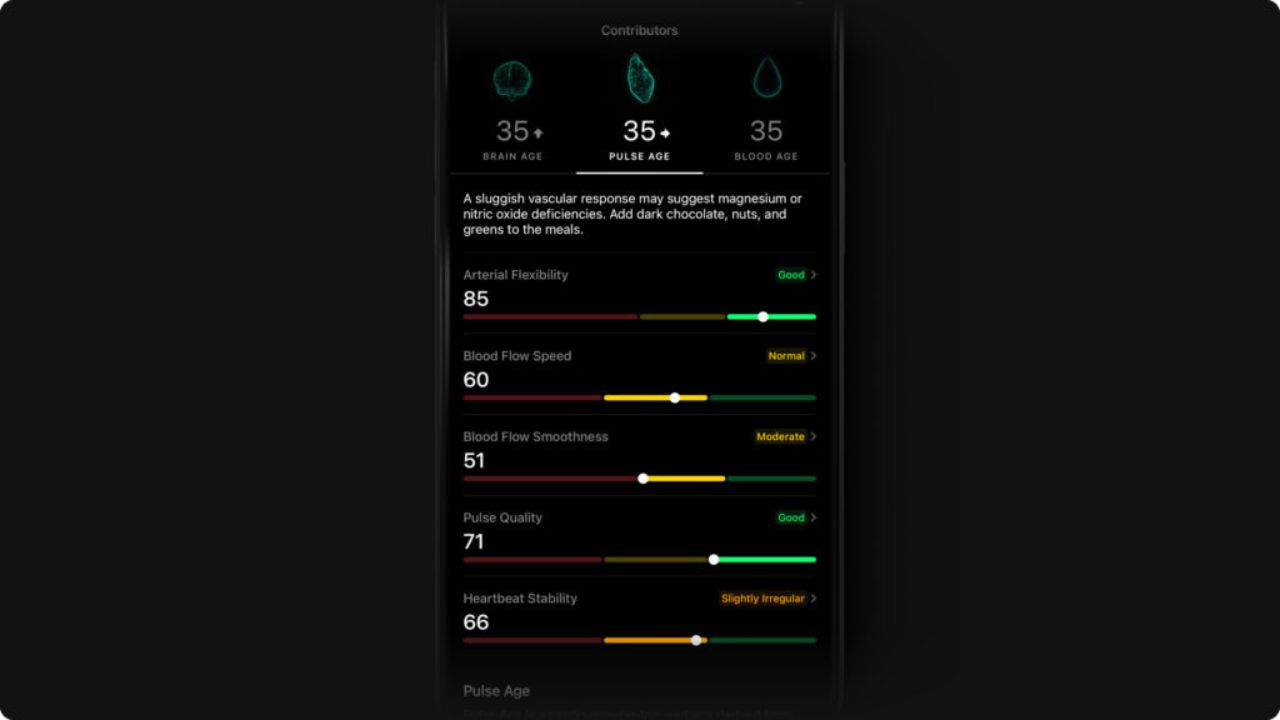
The second component shifts focus to cardiovascular health.
Using signals from the Ring AIR’s optical sensors, Ultrahuman estimates things like arterial flexibility, pulse smoothness, heartbeat stability, and blood flow patterns.
Why does that matter?
Because arterial stiffness is closely tied to cardiovascular aging and can increase the risk of conditions like heart disease or stroke over time. On the flip side, things like exercise, nutrition, and consistent recovery can improve vascular health.
Pulse Age is essentially trying to estimate how “young” or “stressed” your cardiovascular system appears based on those patterns.
Blood Age adds a deeper metabolic layer
This is the only part that goes beyond wearable data.
If you’ve taken Ultrahuman’s Blood Vision test, available in markets like India and the US, Ultra Age can also incorporate blood biomarkers into the equation.
That includes markers related to inflammation, cholesterol balance, glucose regulation, and immune function. Together, they provide a broader look at how your organs and metabolic systems are functioning internally.
A healthier Blood Age generally points toward lower inflammation and better metabolic resilience.
The most useful part might actually be the “speed of aging”
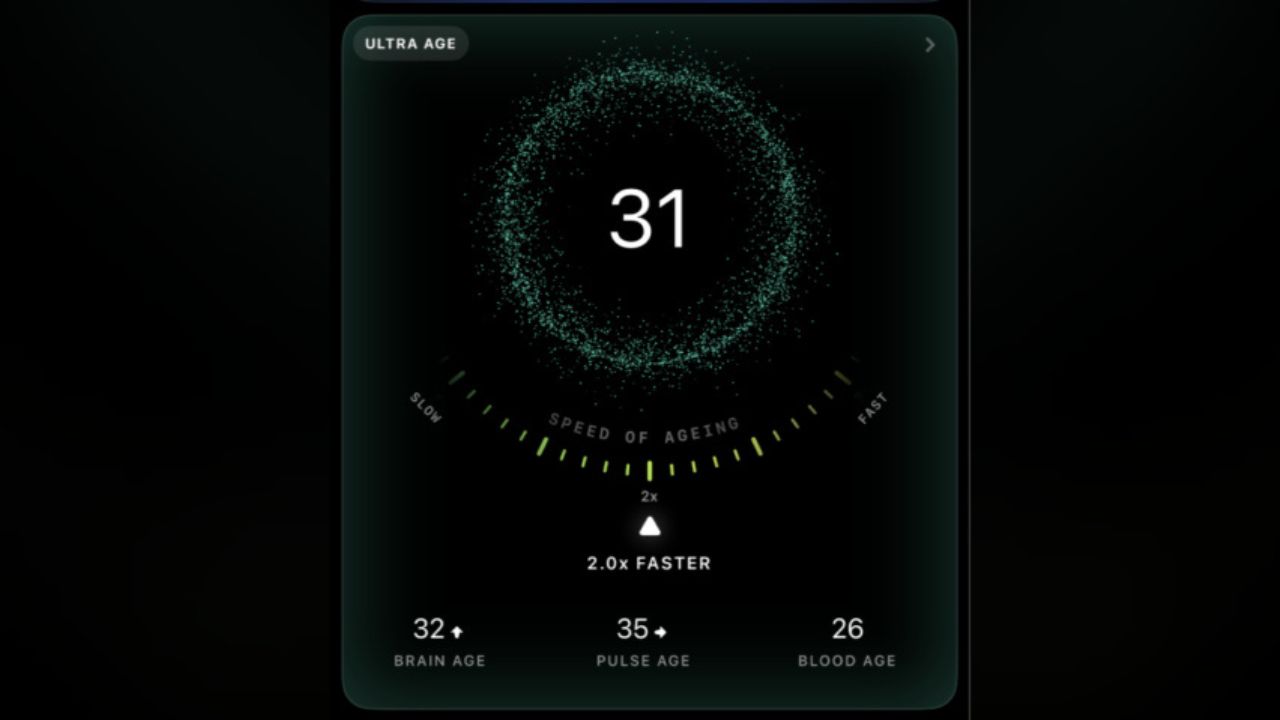
Interestingly, the feature doesn’t stop at giving you a number.
Ultra Age also tracks your “speed of aging,” essentially whether your body appears to be aging faster or slower than expected over time.
That’s where the feature starts becoming more practical.
If your sleep improves, stress drops, and recovery becomes more consistent, you may see your aging speed slow down. On the other hand, sustained sleep debt, elevated stress, poor cardiovascular recovery, or inflammation markers can push things in the opposite direction.
It turns aging into something dynamic rather than fixed.
This is less about lifespan and more about direction
It’s important to understand what Ultra Age is and what it isn’t.
It’s not predicting how long you’ll live. And it’s not a medical diagnosis.
What it does try to do is show whether your current habits are pushing your health in a better or worse direction over time.
That makes it less about fear and more about feedback.
Instead of waiting years for the effects of poor sleep, stress, or unhealthy habits to show up, the idea is to surface smaller physiological changes earlier, while they’re still actionable.
A broader shift in how wearables think about health
Ultra Age also reflects a bigger trend in wearable tech.
Companies are moving beyond simple activity tracking and trying to build a more complete picture of long-term health. Sleep, recovery, cardiovascular signals, and metabolic markers are no longer treated as separate categories. They’re increasingly being connected together.
That’s essentially what Ultra Age is trying to do.
Rather than overwhelming users with isolated metrics, it combines multiple health signals into a single view that’s easier to understand, while still letting users dig into the details if they want to.
And for people already trying to improve sleep, fitness, stress management, or recovery, that broader context may end up being more useful than any individual score on its own.
Also Read: Speakers by JBL & Sony on Myntra That Bring Depth Into Every Beat