
Air travel has always come with a trade-off.
It connects places quickly, but it also comes with a measurable environmental cost. For a long time, that cost stayed mostly invisible to travelers. Flights were compared on price, duration, and convenience, while emissions stayed in the background.
That has started to change.
Platforms like Skyscanner now bring sustainability into the same space as pricing and timing, which basically makes it part of the decision and not an afterthought.
Making emissions visible during search
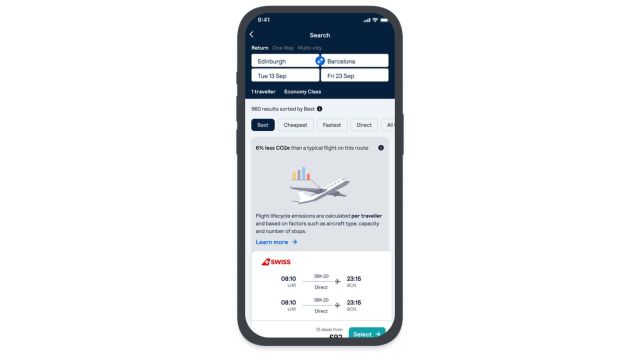
One of the more noticeable shifts is how flight results are presented.
Alongside price and duration, certain flights are marked as having lower emissions compared to typical routes. This doesn’t mean zero impact, but then it does introduce a reference point.
Instead of treating all flights as equal, there’s now a visible difference between:
- More efficient routes
- Standard options
- Higher-emission alternatives
This small addition changes how comparisons are made. It places environmental impact next to cost and convenience, and not somewhere separate.
Why some flights have lower emissions
Not all flights produce the same level of emissions, doesn’t matter if they’re on similar routes.
A few factors influence this:
Aircraft type and fuel efficiency
Number of stops
Route efficiency and distance
Airline operations and load factors
For example, a newer aircraft on a direct route may produce fewer emissions than an older aircraft with multiple stops, even if the ticket price is similar.
Skyscanner doesn’t calculate this in isolation. It pulls emission estimates and presents them in a simplified way so the difference is easier to understand.
The role of route selection
Sustainable travel isn’t just about airlines. The route itself plays a role.
Direct flights are often more fuel-efficient than multi-stop journeys because in such cases takeoffs and landings consume a good amount of fuel. However, this isn’t always consistent, because aircraft type and route structure can even offset that advantage.
By showing emissions alongside routes, Skyscanner highlights how these variations play out in real scenarios.
Moving beyond price-first decisions
Traditionally, flight searches have been driven by one primary factor: price.
Sustainability indicators introduce a second layer.
A flight that is slightly more expensive but significantly lower in emissions becomes a visible option. It’s no longer hidden behind technical data or separate research.
This doesn’t force a decision, but it expands what is being compared.
The influence of transparency
The biggest shift here isn’t the data itself, but its placement.
When emissions are visible during the search process:
- Awareness increases naturally
- Trade-offs become clearer
- Decision-making becomes more informed
There’s no need for separate tools or calculations. The information is already part of the comparison.
Small shifts, broader impact
Sustainable travel rarely comes down to one large decision.
It’s usually a series of smaller choices:
- Selecting a more efficient route
- Avoiding unnecessary stops
- Choosing airlines with newer fleets
Individually, these changes are small. At scale, they begin to matter.
By integrating sustainability into everyday search, Skyscanner makes those small shifts easier to act on.
Where this fits in the bigger picture
It’s important to recognise the limits as well.
Highlighting lower-emission flights doesn’t eliminate the environmental impact of flying. It simply provides context.
Sustainable travel is broader than one tool or one platform. It includes:
- Travel frequency
- Mode of transport
- Accommodation choices
- Overall consumption patterns
Skyscanner’s role sits at the point of comparison, where decisions are being made.
The direction this is moving in
The inclusion of sustainability indicators reflects a wider shift in travel platforms.
Instead of focusing only on cost and speed, there’s a gradual move toward more transparent travel data. Environmental impact becomes part of the same conversation.
It doesn’t replace other factors, but it changes how choices are framed.
Final thought
Sustainable travel isn’t defined by a single decision.
It’s shaped by how information is presented and how easily it can be acted on.
By placing emissions data directly into the search process, Skyscanner doesn’t change the nature of air travel. It changes the visibility around it.
And in many cases, that’s where change begins.
Also Read: Stackable Wardrobe Organisers That Do Not Collapse Under Weight