
There is a point during trip planning when a route starts to feel fixed in your head. You know the cities you want to visit, the order seems sensible, and you start searching for flights that fit the plan. Most people stop there because it feels unnecessary to question the route itself.

But flight prices don’t care whether your itinerary feels logical.
A traveler planning a European holiday, for example, might naturally think about flying into Paris, travelling through Switzerland and Italy, and then heading home from Rome. It is a perfectly sensible route. But what happens if you search the same trip in reverse? Rome to Paris, with the rest of the journey running in the opposite direction.
Sometimes the difference is surprisingly large.
This is one of those simple checks that frequent travelers make before booking a multi-city trip. They don’t assume the direction of travel is irrelevant. They compare it.
The Same Cities Can Have Very Different Airfares
Airlines don’t price flights based on how neatly your holiday fits together.
Demand can be completely different in each direction. There may be more people flying from one city to another on a particular day, while the return route has plenty of empty seats. Airlines also have different levels of competition on different routes, which can push prices up or down.
That means an itinerary that looks identical on a map can have a very different price depending on which city you start from.
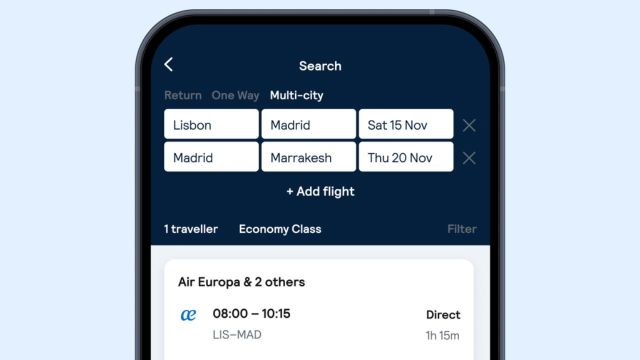
This is where Skyscanner’s multi-city search can be useful. Instead of deciding that City A has to be your starting point, compare both versions. Put City A first in one search, then swap the order and see what happens.
You might discover that changing the direction saves enough money to make the entire itinerary more attractive.
It Can Also Change the Cost of Your Internal Travel
There is another part of this hack that is easy to overlook.
Your international flights aren’t the only expenses affected by the direction of your trip. Hotels, trains and domestic flights can all vary depending on when you’re travelling through a particular city.
Suppose you’re planning a two-week trip through Spain. You could fly into Barcelona, travel through Valencia and Seville, and finish in Madrid. But perhaps your dates line up with a busy weekend in Barcelona, making both flights and hotels unusually expensive.
Reverse the trip, and you might reach Barcelona during quieter weekdays while spending the weekend somewhere else.
Suddenly, changing the direction of the itinerary has saved money beyond the airfare itself.
The Cheapest Direction Isn’t Always the Best Direction
Of course, there is no point saving ₹5,000 on flights if the reversed itinerary forces you to spend ₹8,000 more on trains or hotels.
That’s why the hack needs to be treated as a comparison rather than a rule.
Look at the complete trip in both directions. Check the international fares, the cost of moving between cities, accommodation prices and how much time you’ll spend travelling. Sometimes one direction will clearly win. Other times the difference will be so small that you’ll prefer whichever route feels more convenient.
The useful part is knowing that you have another option.
It Works Particularly Well for Multi-Country Trips
This becomes even more interesting when several countries are involved.
Imagine a traveler planning a route through France, Switzerland, Italy and Austria. There isn’t necessarily one correct way to do it. You could start in Paris and work east, or begin in Vienna and work west. You could even alter the order depending on flight prices.
If you’re already moving between countries by train or short regional flights, changing the starting airport doesn’t necessarily change the trip very much.
But it can change the price of the international flights considerably.
That is why experienced travelers often choose the cheapest sensible entry and exit points first, then build the route between them.
Don’t Let the First Search Become the Final Decision
The first itinerary you find can be surprisingly persuasive.
Once you’ve seen a reasonable price and imagined the trip around it, starting over feels like unnecessary work. But that is exactly when it can be worth taking another look.
Before booking a multi-city holiday, reverse the route once. It takes only a few minutes on Skyscanner, and you may find that the same holiday looks different when the journey runs in the opposite direction.
Most of the time, the difference may be small.
Every now and then, though, the reverse route can save money, fit the schedule better and even make the trip easier. The cities haven’t changed. The holiday hasn’t changed. You’ve simply stopped assuming that there is only one way to connect them.
Also Read: The Workplace Is Getting Smarter, Here’s Where AI Skills Come In