There is a slightly strange phase happening in workplaces right now.
People are using AI every day, but a lot of them still do not feel particularly confident about it.
Someone might use Gemini to clean up a piece of writing. Another person might ask an AI tool to summarise a long document. A manager could use it to brainstorm ideas for a presentation, while a student might use it to organise study material.
The tools are already here. The harder part is figuring out how to use them well.
That distinction is becoming increasingly important as AI moves from being an interesting experiment to becoming part of ordinary work. Knowing that an AI tool exists is no longer much of a differentiator. Knowing how to work with it, understand its limitations and use it to solve practical problems is much more useful.
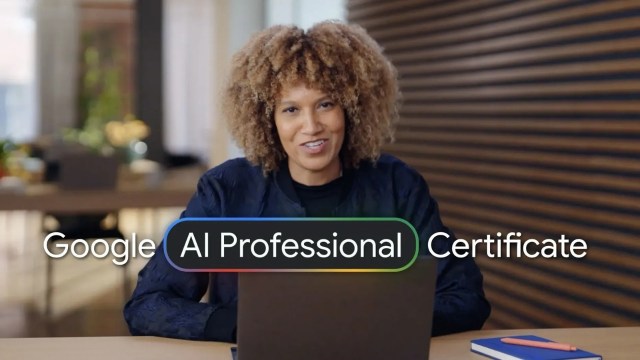
That is the thinking behind Google’s AI Professional Certificate on Coursera.
The point is not simply to “learn AI”
The phrase “AI skills” can mean almost anything these days.
It could refer to machine learning, programming, data science or building large AI systems. But there is another category that is becoming increasingly relevant to people who do not intend to become AI engineers.
That is practical AI fluency.
The Google AI Professional Certificate is designed around this idea. The programme consists of six short courses and a capstone project, with learners working with tools including Gemini, NotebookLM and AI Studio.
The emphasis is on using AI in practical situations, rather than treating it as a purely theoretical subject.
That makes the programme particularly relevant to working professionals who want to understand how AI can fit into the work they already do.
Think less about prompts and more about problems
A lot of the conversation around AI has become obsessed with prompting.
There is value in knowing how to communicate clearly with an AI system, but that is only part of the picture.
The more useful skill is knowing what you actually want the technology to accomplish.
Suppose you have a pile of research notes and need to turn them into a coherent project plan. Or you have a complicated subject to understand before a meeting. Perhaps you want to brainstorm several approaches to a business problem, create a first draft or automate a repetitive task.
The technology becomes much more useful when you start with the problem rather than the tool.
The Google AI Professional Certificate is structured around this kind of practical application. The brief specifically highlights productivity, creativity and problem-solving, along with hands-on exercises and a capstone project that can result in an AI-powered portfolio project.
That last part is worth paying attention to.
Learning something is useful. Building something with it gives you something concrete to show.
The capstone changes the nature of the learning
Online learning can sometimes become a collection of completed lessons that disappear into a browser history.
A project gives the experience more substance.
As part of the Google AI Professional Certificate, learners complete a capstone that allows them to put their knowledge into practice and build an AI-powered solution. The campaign brief positions this as a way to create a portfolio that can demonstrate practical skills to potential employers.
For someone trying to future-proof their career, that distinction matters.
It is easier to talk about your AI skills in an interview when you can point to something you actually built or explain a problem you solved with the technology.
You do not have to present yourself as an AI expert overnight. You can instead demonstrate that you understand how to use these tools thoughtfully and productively.
There is more to AI than generating text
One of the more interesting aspects of the programme is the range of activities outlined in the campaign.
AI can be used to understand complex concepts, organise study plans, brainstorm project ideas and help build portfolio projects. It can also support everyday professional tasks, from preparing resumes and cover letters to practising interview questions and automating routine work with Gemini.
That makes the learning feel less tied to one profession.
A marketer, analyst, designer, recruiter, student or project manager could potentially find different ways to apply the same underlying skills.
The goal is not to make every person work in exactly the same way. It is to help people understand where AI can remove friction from the work they are already doing.
And then there is Google AI Pro
There is an additional reason the programme is getting attention at the moment.
For a limited time, people who enrol in the Google AI Professional Certificate on Coursera receive three months of Google AI Pro at no extra cost.
The campaign is clear that the Professional Certificate remains the primary product. Google AI Pro is the promotional benefit attached to the enrolment.
The premium AI plan can complement the learning experience by providing advanced Gemini capabilities that can help with things such as understanding complicated topics, organising study materials, generating ideas and working through projects.
In practical terms, that means learners can use AI not just as something they are studying, but as part of the process of studying and building.
AI skills are becoming a career conversation
There is a broader career question behind all of this.
You do not necessarily need to abandon your current profession because AI is changing it.
In many cases, the smarter move could be to understand how AI intersects with the work you already know.
An accountant who understands AI-assisted workflows has a different skill set from an accountant who ignores them. The same applies to a marketer, designer, consultant, teacher, analyst or project manager.
The advantage is not necessarily knowing every new AI tool that appears. That would be almost impossible.
It is developing enough practical understanding to evaluate these tools, use them effectively and recognise when a task still needs human judgement.
That is why workplace-focused AI education is becoming more relevant.
The current Coursera offer makes the timing interesting

There is also a financial incentive for learners in India who have been waiting to start.
Coursera’s Mega Sale began on August 18, 2026, bringing the price of a full year of subscription down to Rs 7,499 from the usual Rs 13,999. The offer runs until September 23, 2026.
For someone who wants to explore AI properly rather than rush through a single course, a full year of access can actually make a difference. It gives you room to learn at your own pace, revisit material and also potentially explore other subjects alongside the Google AI Professional Certificate.
The flexibility is particularly useful for working professionals. Not everyone can dedicate several hours every evening to an online programme. Sometimes learning happens during a commute, over a weekend or in small pockets of time between meetings.
A modular programme fits that reality better than a rigid classroom schedule.
The real skill is knowing what to do with AI
AI is not going away, but neither is the need for people who can think critically about how it should be used.
That is perhaps the most useful way to look at the Google AI Professional Certificate.
It is not simply about learning a collection of AI tools. It is about becoming more comfortable with the technology, experimenting with practical applications and building solutions that can have a place in real work.
The combination of six courses, hands-on exercises and a capstone gives learners a structured route into that process. The temporary three-month Google AI Pro benefit adds another practical layer, while the current Coursera India Mega Sale makes the overall timing more appealing for people who have been considering an investment in their skills.
AI may already be changing the workplace. The more interesting question is what you are going to do with it.
Also Read: Stepper Machines for Compact Cardio Workouts in Small Homes from Amazon