
There is a small argument that happens in plenty of Indian kitchens. Someone wants to buy ghee, someone else insists on getting the same brand and variety as last time, and the person placing the order is left wondering whether there is really any difference between all those jars. Cow ghee, A2 cow ghee, buffalo ghee, Bilona ghee. The labels can make a fairly ordinary grocery purchase feel unnecessarily complicated.

But the choice becomes easier when you stop looking at ghee as one interchangeable ingredient. Think about how it is actually used at home. The ghee that goes into everyday dal or is spread over a hot roti may not be the same one you would reach for when preparing a batch of halwa or making festive sweets. And that is a perfectly reasonable place to begin when deciding what to buy.
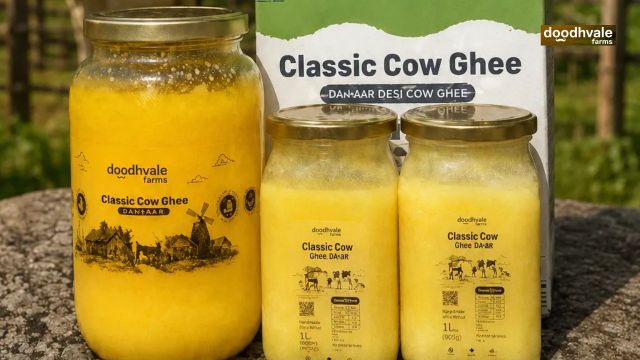
For everyday cooking, a familiar cow ghee is often the practical option. It can be used for tempering dals, finishing khichdi, making parathas or adding a little richness to vegetables. Doodhvale Farms’ Classic Cow Bilona Ghee is designed around this kind of regular use. It is made from cow milk sourced from the brand’s own farm in Sonipat, Haryana, and follows the traditional Bilona process.
The process itself is worth understanding. Milk is first converted into curd, which is then hand-churned to obtain makkhan. That makkhan is slow-simmered to make ghee. Doodhvale describes the resulting product as danedaar, referring to its grainy texture, with a distinct aroma. Instead of a vague promise of old-school preparation, these details give buyers a more concrete idea of what they’re in for.
Then there is A2 cow ghee, which has become a more familiar sight on grocery shelves. Doodhvale Farms’ Cow A2 Desi Ghee is made from the milk of Sahiwal and Gir cows raised on its farm. It is described as golden, aromatic and danedaar. For someone who specifically wants a product sourced from these breeds and made through the Bilona method, those are useful details to look for when comparing options.
And buffalo ghee deserves its own place in the conversation. It has a richer, more robust flavour profile, which makes it particularly suited to certain Indian preparations. Think about a festive halwa, a batch of homemade sweets or even parathas made for a leisurely weekend breakfast. Doodhvale’s Royal A2 Buffalo Desi Ghee is made from the milk of Murrah buffaloes from its farm and is positioned for precisely these kinds of uses.
Of course, buying different varieties does not mean every household needs three jars sitting on the kitchen shelf. Storage space, monthly grocery budgets and actual consumption all matter. A smaller 330 ml jar can be a sensible way to try a variety before committing to a larger pack, while the 825 ml option is more suited to households that already know what they prefer. Doodhvale also offers a 5-litre Cow A2 Dolchi for larger families and regular bulk use.
There is one more thing worth checking before placing an order: where the product comes from and what information the brand makes available. Doodhvale Farms operates its own dairy farm in Sonipat, established in 2017, and provides batch laboratory reports and its FSSAI licence through the Doodhvale app. These are details buyers can check rather than relying only on claims printed on a label.
So, the next time someone asks which ghee to buy, there is no need to look for one universal answer. Start with the food your household actually cooks, consider the flavour you prefer, and choose a pack size that makes sense for your consumption. A little thought before ordering can save you from buying a large jar of something that eventually sits unused at the back of the kitchen shelf.
Also Read: Biryani, Fried Rice, Hakka Noodles and Pulao: What to Order When Everyone Wants Something Different