
For a startup, the first version of a product has a slightly awkward job.
It needs to be useful enough for people to try, but it also needs to be built before the company has burned through a large part of its early budget. Founders are essentially making bets with incomplete information. They may have a strong idea about the problem, but they won’t really know which features matter until someone uses the product.
That has always made building an MVP a balancing act.
Build too little and there may not be enough for users to react to. Build too much and the startup can spend months developing features that looked important in a planning meeting but barely get used.
AI-powered development tools are changing how some startups approach that first build.
An MVP is really a learning exercise
An MVP is sometimes treated as simply a cheaper version of a finished product. That’s not quite the point.
A good MVP should help a startup answer questions. Do customers understand the product? Does the proposed workflow make sense? Are people willing to use it regularly? Which features are genuinely useful and which ones sounded better on paper?
Those answers are difficult to get from a presentation or a collection of wireframes.
Give someone a working product, however, and the conversation changes. They can tell you where they got stuck, what they expected to happen next, and which parts they would actually use.
The challenge has always been reaching that stage without spending a huge amount on development first.
AI is changing the first development cycle
Traditional MVP development can involve several different people and processes. There is the interface to design, the application logic to build, a database to set up, integrations to connect, and testing to complete before the first version is ready.
AI-assisted development can compress some of that groundwork.
A founder can describe the product in ordinary language, explain what customers should be able to do, and outline the workflow. An AI development platform can use those instructions to generate a working starting point instead of requiring every element to be created manually.
That does not mean a startup can describe an idea once and immediately have a flawless product. Generated software still needs testing, refinement, and, depending on the project, technical review.
The difference is that there can be something real to work with much earlier.
Founders don’t necessarily have to wait for a full technical team
This is particularly interesting for early-stage companies.
A founder might understand a particular industry extremely well and have spotted a problem worth solving, while having little experience with software development. Previously, exploring that idea could mean finding a technical co-founder, hiring developers, or bringing an agency into the picture before there was any evidence that customers wanted the product.
AI doesn’t make those people unnecessary. It gives founders another way to investigate an idea before making a large commitment.
That can be useful when the objective is simply to find out whether the concept has legs.
The first version is supposed to change
One thing founders learn quickly is that an MVP rarely stays an MVP for long.
The first users may ignore a feature that seemed essential and repeatedly ask for something nobody had considered. A signup process might turn out to be unnecessarily complicated. A workflow that looked perfectly logical during planning may feel completely different when someone uses it for the first time.
Being able to make those changes without restarting the entire development process becomes valuable.
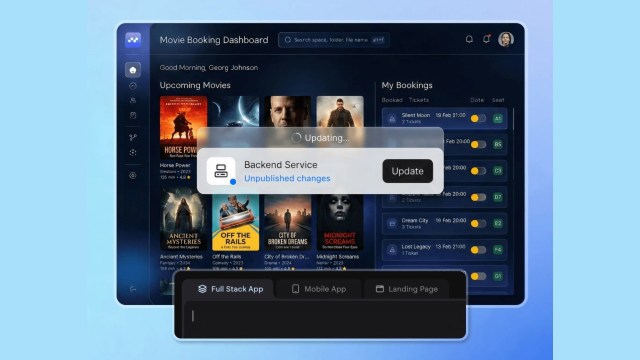
This is one area where Emergent fits into the changing development process. The platform can take natural-language instructions and use them to build full-stack applications, covering the interface as well as the backend, database, APIs, and application logic. Once a project exists, users can continue describing changes and additions rather than treating every modification as a separate build.
It can be used for web and mobile projects, including SaaS products, customer portals, dashboards, booking systems, internal tools, websites, and AI applications. Developers can also connect projects with GitHub when they want to bring them into an established version-control workflow.
There is room to start small
Emergent has a no-cost option for people who want to test the platform, with 10 credits available each month. It also includes the core platform, web and mobile development, one-click LLM integration, and access to its latest AI models.
For users who need more capacity, Standard is $20 a month or $204 for a year. That brings the monthly allowance up to 100 credits and adds things such as private project hosting, GitHub integration and task forking. Additional credits can also be purchased when required.
The Pro tier is $200 monthly or $2,004 annually, with 750 monthly credits. It is aimed at more intensive work and adds a one million-token context window, high-performance computing, custom AI agents, advanced reasoning capabilities, and priority support.
The choice of plan is obviously going to depend on how much someone is building and how often they use the platform. For a founder testing an idea, the more important point may simply be that they can start experimenting before committing to a larger development budget.
The real advantage is finding out what works
Speed by itself isn’t much of a competitive advantage if a startup is building the wrong thing.
What matters is how quickly a team can move from an assumption to evidence.
A working MVP gives founders something to put in front of potential customers. Their feedback can shape the next version, which can then be tested again. Sometimes that process confirms the original idea. Sometimes it sends the product in an entirely different direction.
AI-powered development makes that cycle easier to start because the first technical hurdle is no longer quite as high.
For startups, that could prove more important than simply being able to build an app faster. The real benefit may be having the freedom to test an idea, change it when the evidence says it needs changing, and decide how much to invest only after there is something worth investing in.
Also Read: The Kind of Luggage Packed Can Change the Kind of Hotel That Makes Sense