

Most businesses already have more data than they know what to do with.
Customer records sit in one system. Sales figures live somewhere else. Operations teams keep their own reports. Important information may also be buried in spreadsheets that have been passed around for years.
The problem is rarely a complete absence of data.
It is getting the right information in front of the right person at the right moment.
That is an interesting problem for AI-assisted app development because software can now be created around a company’s particular information instead of asking the company to reshape its processes around a generic application.
Data becomes useful when someone can act on it
A spreadsheet containing thousands of rows isn’t necessarily useful to the person who needs to make a decision.
A sales manager may want to know which accounts have gone quiet. A warehouse supervisor may care about items that have been sitting too long. A finance team might need to see which invoices require attention.
The underlying data may already exist.
What is missing is a practical way of turning it into something people can work with.
A custom application can provide that layer. Instead of asking employees to search through several systems, it can present the information according to the decisions they actually need to make.
The same data can mean different things to different teams
This is where generic dashboards often fall short.
A senior manager may want a broad overview. An operations employee may need individual records. A sales representative may care about today’s follow-ups rather than the company’s quarterly figures.
Giving everyone the same screen doesn’t necessarily make information more accessible.
A business-specific application can be designed around these different roles. The underlying data can remain connected while the interface changes according to what each person is responsible for.
That sounds like a small design decision, but it can make a substantial difference to how software gets used.
AI makes the first version easier to describe
A business doesn’t necessarily need to start by designing an elaborate data architecture.
It can begin by explaining what the application should help people do.
For example, a company could describe a system in which managers see outstanding orders, employees update individual records and customers receive status information without accessing internal notes.
That description establishes the behaviour the software needs to support.
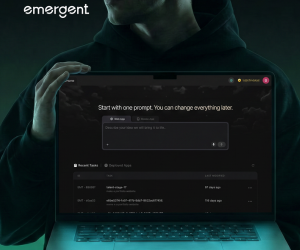
AI-assisted development can then help turn the requirements into an application. Emergent is one platform using this approach, allowing users to generate full-stack web and mobile applications through natural-language instructions.
The important part is that the software can be shaped around the company’s workflow and information rather than forcing the business to accept whatever structure comes with a ready-made product.
There is a difference between connecting data and understanding it
AI can help build interfaces around information, but businesses still need to understand the information itself.
A dashboard showing a number doesn’t explain whether that number is accurate.
Data from different sources may use different definitions. Two systems might classify customers differently. One department may consider an order “complete” when it ships, while another may use the term only after delivery.
These inconsistencies have to be resolved before they become software logic.
Otherwise, a beautifully designed application can simply make bad information easier to read.
Access matters as much as presentation
Once a company brings multiple sources of information into one application, permissions become particularly important.
An employee may need access to customer contact details but not financial records. A manager might need broader visibility without being able to change certain administrative settings.
Those rules need to be designed deliberately.
The same applies to information pulled from external services. Credentials should be protected, data transfers should be controlled and businesses should know exactly which systems are sharing information with the new application.
AI can help with implementation, but access decisions belong to the people responsible for the business and its data.
A useful application may sit on top of existing systems
Building around company data doesn’t necessarily mean replacing the software that stores it.
A business might keep its CRM, accounting system and inventory platform while creating a separate application that brings selected information together for a particular team.
That can be a more practical approach than attempting to replace several established systems at once.
The custom application becomes a working layer between the company’s data and the people who need to use it.
This is one reason AI-assisted development is interesting for internal software. The goal doesn’t always have to be another giant platform. Sometimes it is simply a better way of using what the business already has.
The cost depends on how far the idea goes
Emergent’s plans are structured for different levels of development activity.
The Free plan includes 10 monthly credits, with access to core web and mobile app development, one-click LLM integration and the latest AI models.
The Standard plan costs $20 per month or $204 per year and provides 100 monthly credits, private project hosting, GitHub integration, task forking and the option to purchase additional credits.
For more intensive projects, Pro costs $200 per month or $2,004 per year. It includes 750 monthly credits, a 1-million-token context window, high-performance computing, custom AI agents, advanced reasoning capabilities and priority customer support.
That makes it possible to approach a data-driven application incrementally: connect the information that matters, test the workflow and expand the system if people actually find it useful.
The interesting part isn’t having more data
Businesses have spent years collecting information.
The next challenge is making that information easier to use without creating another layer of administrative work.
AI app development doesn’t solve poor data quality or magically determine what a business should measure. It can, however, reduce the effort involved in creating software around a particular workflow.
That changes the question from “Which software already has the dashboard we need?” to something more specific: “What would the software look like if it were designed around the information our people actually use?”
For some businesses, that difference could be enough to turn data that has been sitting in separate systems into something people can finally act on.
Also Read: How the Ultrahuman Ring Tracks Sleep Stages and What the Data Means