
There is a massive difference between booking a ten-day holiday and booking a flight for a six-month internship, a study exchange, or a foreign work assignment.
With a holiday, you buy a round-trip ticket, pack a light carry-on, and count down the days. But when you are moving your life to another country for the foreseeable future, the logistics get messy fast. You are dealing with visa paperwork that might not arrive on time, massive amounts of luggage, and the nagging uncertainty of not knowing exactly when you’ll want to come home.
If you just search for the cheapest flight on Skyscanner the way you would for a weekend getaway, you are setting yourself up for a headache.
When you are planning a long-term international stay, you have to play the long game. Here is a practical, unfiltered guide on how to make Skyscanner work for your relocation, rather than against it.
1. Defeating the “Proof of Onward Travel” Trap
Here is a scenario that happens to thousands of long-term travelers every year: You show up at the airport check-in desk with your one-way ticket, ready to start your year-long digital stint or an internship. The agent asks to see your return ticket. You explain that you have a resident visa or that you plan to buy a return ticket later. The agent shakes their head and says, “No proof of exit, no boarding.”
Many countries—and airlines, who are legally responsible for flying you back if you are denied entry—strictly require proof of onward travel before they let you on the plane.
But booking a expensive, rigid return ticket six months in advance is a waste of money, especially when you don’t know your exact departure date.
The Skyscanner Hack:
Instead of buying a pricey return ticket you will probably have to change anyway, use Skyscanner to find a “throwaway” or ultra-cheap exit ticket.
1. Set your departure to your destination city (e.g., Tokyo).
2. Set the destination to “Everywhere”.
3. Search for a date just before your initial tourist entry or visa checkpoint expires.
4. Filter by price.
You will often find a cheap, $20 budget flight to a neighboring country (like Tokyo to Seoul, or London to Brussels). Buying this useless, cheap ticket serves as your legal proof of exit for immigration officers, saving you from having to book an expensive return flight home before you are ready.
2. Hauling Your Life: The Real Cost of Baggage
Let’s be realistic: you are not moving to Berlin for a winter semester with a single backpack. You are going to have at least one massive checked bag, probably two, plus a heavy carry-on stuffed with laptops, documents, and winter coats.
This is where Skyscanner’s search results can be incredibly deceptive if you only look at the headline price. Ultra-low-cost carriers make their money by charging extortionate fees for checked bags at checkout. A flight that looks like a $150 steal can easily balloon to $350 once you add 30kg of luggage.
How to filter for reality:
Look at the Aircraft and Carrier Type: If Skyscanner shows a legacy carrier (like Air France, ANA, or Delta) and a budget carrier (like Ryanair or Spirit) at similar price points, always go with the legacy carrier. Legacy airlines almost always include a checked bag in their standard economy tier (not the “basic economy” tier, so check closely), and their fees for a second bag are usually far more reasonable.
Click Through to the Fare Families: When Skyscanner redirects you to the airline’s booking page, don’t just click the cheapest option. Compare the “Standard” or “Classic” economy tiers. Often, upgrading to the next tier up is cheaper than buying a “Basic” ticket and adding a heavy bag as an afterthought.
3. The “Whole Month” Search for Stress-Free Moving Days
If you are starting an internship or a university term on October 1st, you probably want to arrive somewhere around September 15th to find an apartment, set up a local bank account, and get your bearings. You have a wide, flexible window of about two weeks to make the move.
Do not arbitrarily pick “September 15th” as your flight date. Flying on a Friday or Saturday when everyone else is traveling is a recipe for long airport lines, crowded planes, and inflated prices.
The Smart Way to Find Your Window:
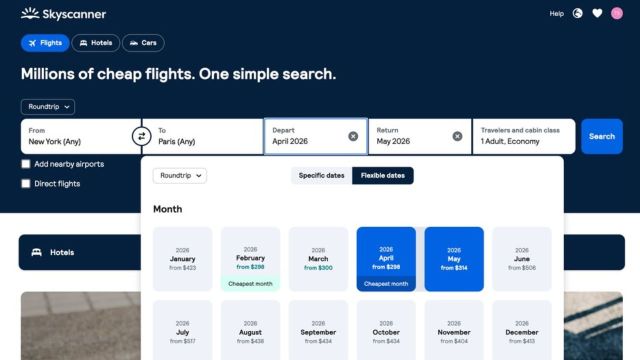
Instead of selecting a specific date on Skyscanner, click the calendar icon and select “Whole Month”, then choose your arrival month.
This gives you a bird’s-eye view of the entire month’s pricing. You might find that flying on Tuesday, September 12th is half the price of flying on Friday, September 15th. Arriving three days earlier not only saves you a couple of hundred dollars, but it also gives you a quiet weekday to run errands, visit landlords, and handle administrative tasks when government offices and banks are actually open.
4. Embracing the Pivot: The Multi-City Safety Net
When you move abroad for a long period, your plans will change. You might start an internship in Barcelona, make friends, and decide to spend your winter break backpacking through Eastern Europe before flying home from Prague. Or, your work contract might get extended, changing your departure hub entirely.
Booking a standard round-trip ticket locks you into a geographical corner. If you have to fly back to Barcelona just to catch your flight home to Chicago, you are wasting time and money.
This is where Skyscanner’s Multi-City tool becomes a logistics lifesaver.
Instead of booking a standard return, try to form your move as an “open-jaw” flight. For example:
Flight 1: Chicago (ORD) to Barcelona (BCN) — Your relocation flight.
Flight 2: Prague (PRG) to Chicago (ORD) — Your return flight after your post-internship travels.
Because Skyscanner compares prices across alliances, it can often package these mismatched routes into a single, surprisingly affordable ticket. It gives you the freedom to explore without forcing you to backtrack to your original starting point just to go home.
The Takeaway
Moving abroad is exhausting. Between apartment hunting, language barriers, and visa stress, the last thing you need is a flight ticket that restricts your movement or hits you with surprise fees at the terminal.
When using Skyscanner for a long-term stay, stop looking for the absolute cheapest flight. Look for the flight that gives you room to breathe. Use the “Whole Month” tool to find a calm, mid-week travel day; filter heavily for carriers that won’t penalize you for carrying your life in your luggage; and keep your return options open. Your future, slightly less-stressed self will thank you.
Also Read: Perfumes on TIRA Worth Checking Out Before Your Signature Scent Finds Someone Else