
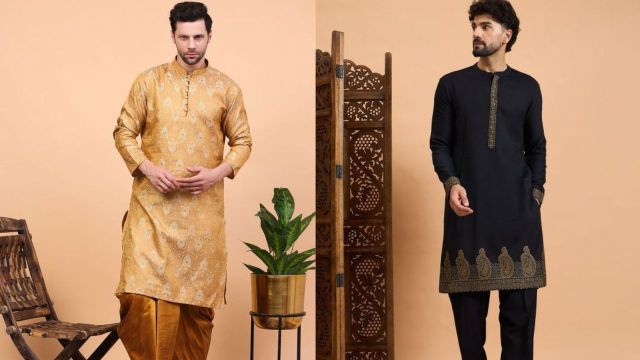
Best mandarin collar kurta pajamas to check out: A mandarin collar does something a regular neckline doesn’t—it sharpens the whole look without adding any extra effort. It feels understated from a distance, but the closer you get, the more it reads as deliberate and put-together.

Top 5 mandarin collar kurta pajama sets worth wearing
This guide focuses on mandarin collar kurta pajama sets that feel easy to reach for, whether it’s a festival, a family dinner, or an office ethnic day. The aim is simple: pieces that sit neatly at the neck, feel comfortable through the day, and hold their shape well enough to look good in photos and in person.
A mandarin collar keeps a kurta looking neat even when everything else is doing a lot—bandhani print, jacquard texture, zari glint, or winter embroidery. That’s why this neckline shows up across very different festive pieces; it creates a clean frame and lets fabric and surface work decide the personality.
The more decorative the outfit, the more “wearable” it becomes only if it’s easy to live with afterward. Embellishment doesn’t always mean sequins; it can be thread work, zari, or a textured weave. In all cases, the same basic rule applies: reduce friction, keep water cool, and don’t twist the garment—because twisting and aggressive agitation are what pull at stitching and distort drape.
The five sets, in detail
JUGG JUGG JEEYO Men Bandhani Printed Mandarin Collar Regular Kurta with Pyjamas
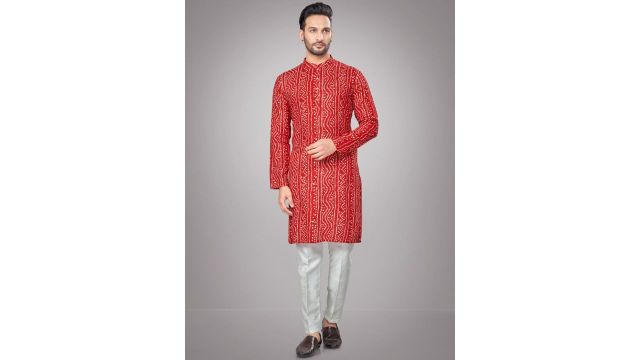
This is unapologetically festive: red, bandhani print, large pattern coverage, and silk-blend fabric from top to bottom. The above-knee length makes it feel slightly less formal than a longer kurta, which helps when the print is already doing the heavy lifting.
Pros
- The print reads celebratory without relying on extra ornamentation.
- Silk and silk blends are often chosen for the way they hold colour and catch light at night.
Cons
- Dry clean only is a commitment during busy wedding seasons, especially if the set is worn more than once.
- Silk-blend fabrics don’t love rough handling; the finish can look tired if washed or stored carelessly.
Pro-tip
- If it comes back from dry clean slightly stiff, airing it out for a few hours usually helps; tight, immediate storage can lock in creases.
House of Pataudi Winter Pashmina Embroidered Straight Kurta With Pyjama
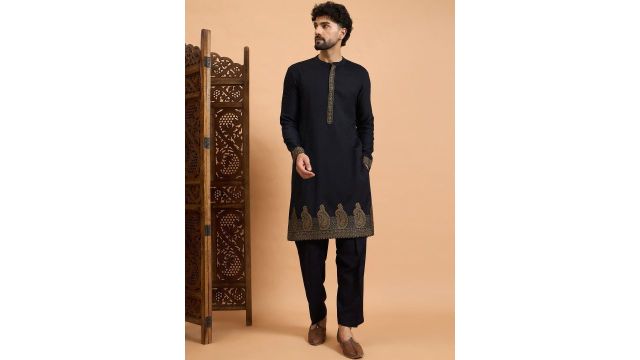
Black wool, subtle embroidery, and a winter-ready feel. It’s the set that makes the most sense when the venue has outdoor bits—entrance photos, terrace functions, late-night goodbyes—because the fabric is doing something practical, not just decorative.
Pros
- Wool is naturally warm, which makes it a rare “festive” fabric that actually earns its place.
- Cold-water washing with gentle handling is widely recommended to prevent shrinkage and misshaping.
Cons
- Indoors, wool can become too much, especially in crowded halls.
- Heat and agitation are the two fastest ways to ruin the fit, even when the label allows machine wash.
Pro-tip
- Treat “machine wash” as “cold, gentle, minimal spin,” then dry flat or reshape while damp; hanging heavy wool can stretch it out.
VASTRAMAY Mandarin Collar Kurta with Dhoti Pants
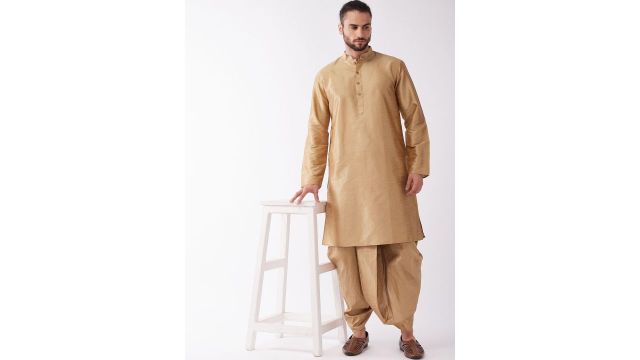
Rose gold, solid, silk blend, paired with a dhoti bottom. It has a slightly ceremonial look without the obvious cues of embroidery, which makes it feel clean and modern—until the dhoti silhouette kicks in.
Pros
- A solid silk blend reads polished immediately, especially under evening lighting.
- Dhoti pants create movement and visual interest without needing extra layers.
Cons
- Dhoti bottoms can feel unfamiliar for anyone used to straight pyjamas; the first wear is a learning curve.
- Dry clean care is typical with silk blends, particularly when the goal is to keep the sheen consistent.
Pro-tip
- Keep the kurta length in check: knee length plus dhoti volume is usually the most balanced proportion for photos.
Also Read: Your Desk Called and It Wants These Logitech Discounts from Amazon
KISAH Ethnic Motifs Embroidered Regular Straight Kurta with Dhoti Pant
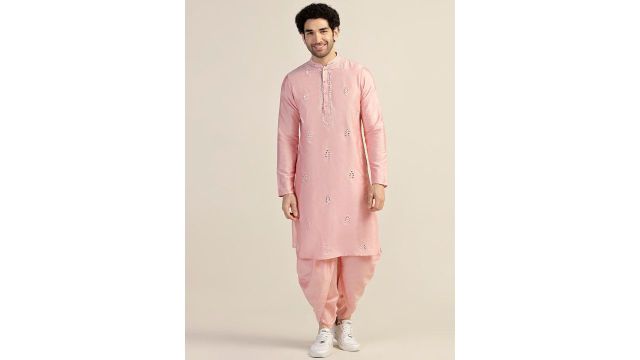
Pink, large embroidery coverage, cotton blend, and a slip-on dhoti pant with an elasticated waist. This is the “festive daytime” option—colour, motif, and silhouette all signal celebration, but the base fabric isn’t trying to be too precious.
Pros
- Cotton blends often balance comfort with better wrinkle control than pure cotton, which helps when the day runs long.
- Slip-on dhoti pants reduce fuss; the waistband does most of the work.
Cons
- Large embroidery coverage increases snag risk, especially around pockets and cuffs.
- Dry cleaning is often the safer route for embroidered pieces because it avoids the rubbing and twisting that damages stitching.
Pro-tip
- Don’t hang it on a thin wire hanger; shoulder points can distort. A broader hanger keeps the kurta line cleaner.
Sydney Heights Ethnic Motifs Woven Design Mandarin Collar Straight Kurta with Patiala
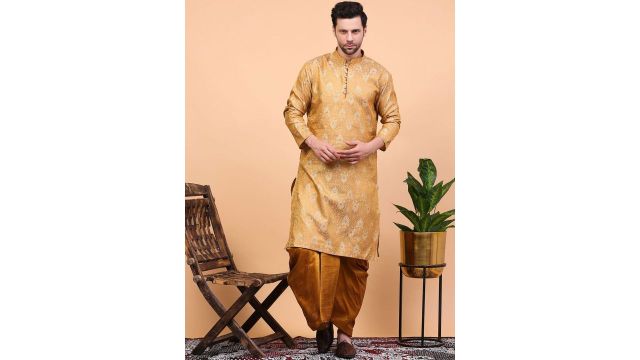
Mustard and gold-toned woven design, zari detail, jacquard weave, and dupion-silk bottoms. It’s the most textured set here; even from a distance, the weave and metallic accents create depth.
Pros
- Jacquard-style woven fabric looks rich without needing heavy embroidery.
- Zari adds highlight in low light and photographs well at night.
Cons
- Metallic threads and textured weaves dislike abrasion; rough washing and tight storage can dull the surface.
- Dupion silk bottoms can crease in a way that looks “pressed-in” if the outfit is packed too tightly.
Pro-tip
- Store with space around it. Metallic details look their best when they’re not rubbing against zippers, denim, or rough hangtags.
Frequently Asked Questions
Which one works best for winter weddings?
A wool kurta set is the most season-appropriate pick because wool is naturally insulating, and cold-water, gentle-care routines are commonly recommended to keep it from shrinking.
Why are silk-blend sets so often dry clean only?
Dry cleaning is frequently recommended for silk because water, heat, and agitation can affect sheen, softness, and colour stability, especially on dressier pieces.
Are dhoti pants actually comfortable?
They can be, mainly because they allow room to move and sit, but they feel best when the waistband is secure and footwear doesn’t catch the hem.
How can embroidery and zari be protected at home?
Minimise friction: wash inside out when possible, use cool water and mild detergent, avoid wringing, and keep embellished areas away from rough fabrics during storage.