

There is a question that tends to appear late in software projects: who actually owns this thing?
It sounds straightforward until an application becomes important to the business.
The company may have paid for its development, but ownership also involves access to the source code, control over data, knowledge of how the application works and the ability to make changes later. Those details matter whether software was written by an in-house team, an outside agency or an AI development platform.
As AI makes it easier to create applications, businesses have a reason to think about software ownership earlier than they might have in the past.
A working app is not the same as a controllable app
Imagine a company has built an internal application that employees now rely on every day.
It works. People like it. The original project is considered finished.
Then a requirement changes.
The company needs a new integration, wants to alter the authentication process or discovers that the application needs to move into a different part of its technology environment.
That is when questions about ownership become practical.
Can the company access the underlying code? Can developers continue working on it independently? Is the data stored somewhere the business can control? Are the credentials and integrations documented?
A business can have a functioning application without having enough control over it.
Source code is only one part of the picture
People often reduce software ownership to one question: “Do we have the code?”
That is important, but it isn’t the whole story.
There is also the application’s data, database structure, third-party integrations, deployment configuration, domain, authentication system and documentation.
A company taking responsibility for an application should understand how these pieces fit together.
This becomes particularly relevant when an application starts out as a small experiment and gradually becomes a critical business system. The decisions that seemed unimportant at the beginning can become difficult to change later.
AI makes the first build easier, but the handover still matters
AI-assisted development changes how an application can be created.
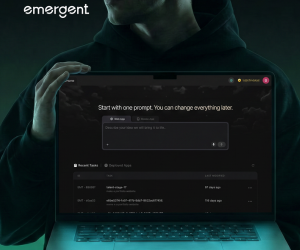
A person can describe the desired functionality in natural language, generate an initial version and continue refining it through further instructions. Platforms such as Emergent are built around this model, supporting the creation of full-stack web and mobile applications.
That can shorten the path from an idea to working software.
It does not, however, answer the ownership questions automatically.
A business still needs to understand where its project lives, how it can access the underlying application, how its information is handled and what options exist if it eventually wants its own engineering team or another service provider to take over.
The faster development becomes, the easier it is to forget that software is something a company may need to live with for years.
Documentation becomes more valuable when the project moves quickly
Fast development can produce another problem.
A project may accumulate changes faster than anyone documents them.
One instruction adds a new workflow. Another changes a database field. A third introduces an external service. A month later, the person who originally created the application may remember why a decision was made, but nobody else does.
That is manageable while the project is small.
It becomes risky when the application starts handling important operations.
Documentation does not have to be enormous. A business should at least know what the application does, where important data lives, which external services it depends on, how access is managed and who is responsible for maintaining it.
The goal is simple: someone else should be able to understand the system without having to reverse-engineer the entire project.
Third-party services can create dependencies
Modern applications rarely operate in isolation.
An application may depend on an email provider, payment service, authentication system, database, analytics platform or AI model.
Those dependencies can be useful, but each one creates another relationship the business needs to understand.
What happens if the provider changes its pricing?
What happens if an API is discontinued?
Can the integration be replaced?
Does the application store information in a format that can be moved elsewhere?
These aren’t necessarily reasons to avoid third-party services. They are reasons to know where the dependencies are.
A small application can become important surprisingly quickly
This is perhaps the easiest thing to underestimate.
A company builds a simple tool to organise customer enquiries. A few months later, the sales team depends on it. Eventually, management uses its reports to make decisions.
The application has quietly moved from experiment to infrastructure.
At that point, questions about backups, security, access management, monitoring and technical ownership become much harder to ignore.
AI doesn’t change that progression. It simply makes it easier for a business to reach the first working version quickly.
That makes it sensible to establish ownership and responsibility before the application becomes indispensable.
How Emergent structures development access
Emergent offers different plans depending on how extensively a team wants to develop and manage its applications.
The Free plan includes 10 monthly credits, with core web and mobile app development, one-click LLM integration and access to the latest AI models.
The Standard plan is $20 per month or $204 per year and provides 100 monthly credits, private project hosting, GitHub integration, task forking and the ability to purchase additional credits.
For more demanding development, Pro costs $200 per month or $2,004 per year. It includes 750 monthly credits, a 1-million-token context window, high-performance computing, custom AI agents, advanced reasoning capabilities and priority customer support.
GitHub integration on the Standard plan is particularly relevant to teams that want their development workflow connected to a version-control environment rather than treating the generated application as a finished, untouchable object.
The useful question isn’t just “Can we build it?”
AI has made that question much easier to answer.
A business can describe an application and, in many cases, get something working without the traditional amount of upfront development effort.
The more interesting questions come afterwards.
Can the company maintain it? Can another developer understand it? Can the data be moved? Can the integrations be replaced? Who has access? What happens if the application becomes more important than anyone originally expected?
Those are ordinary software ownership questions, but AI-assisted development makes them relevant to a much wider group of businesses.
Building the application may be the quick part.
Knowing what you own, how you control it and what happens next is the part worth thinking about before the application becomes too important to lose.
Also Read: From Jeans to Joggers, These Pantaloons Basics Tees Fit Right In